














Exness Stock Indices
Transaction
Exness Stock Indices
Exness’s stock index CFDs cover 10 major indices from global stock markets, including the JP225 (Nikkei 225) and the Dow Jones Industrial Average (US30).Stock index CFDs offer high leverage of up to 200x to 400x (*), allowing you to trade global stock market indices even with a small amount of capital.Additionally, since Exness’s stock index CFDs are swap-free, you can minimize trading costs even when holding positions for extended periods. Enjoy trading with Exness’s stock index CFDs to broaden your trading horizons and seize more opportunities to generate profits.
(*) Leveraged trading involves high risk, and you may lose all of your invested capital. Please ensure you fully understand the risks before trading.
Features of Exness Stock Index CFDs
At Exness, you can trade major global stock market indices—such as the JP225 (Nikkei 225) and the Dow Jones Industrial Average (US30)—via CFDs. Since stock index CFDs differ in some ways from FX trading, please review the characteristics of stock index CFDs beforehand and enjoy trading.
What Are Stock Index CFDs?
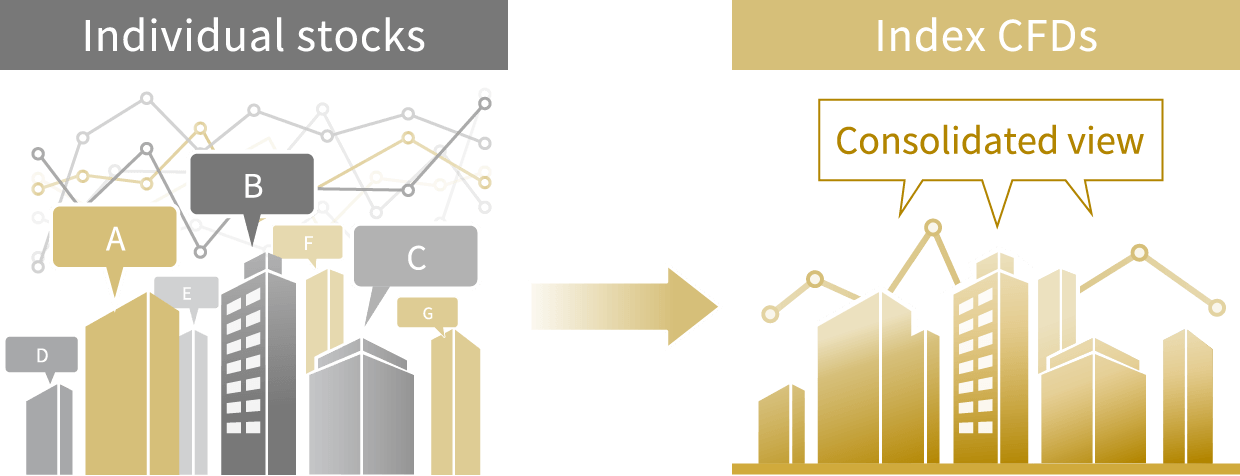
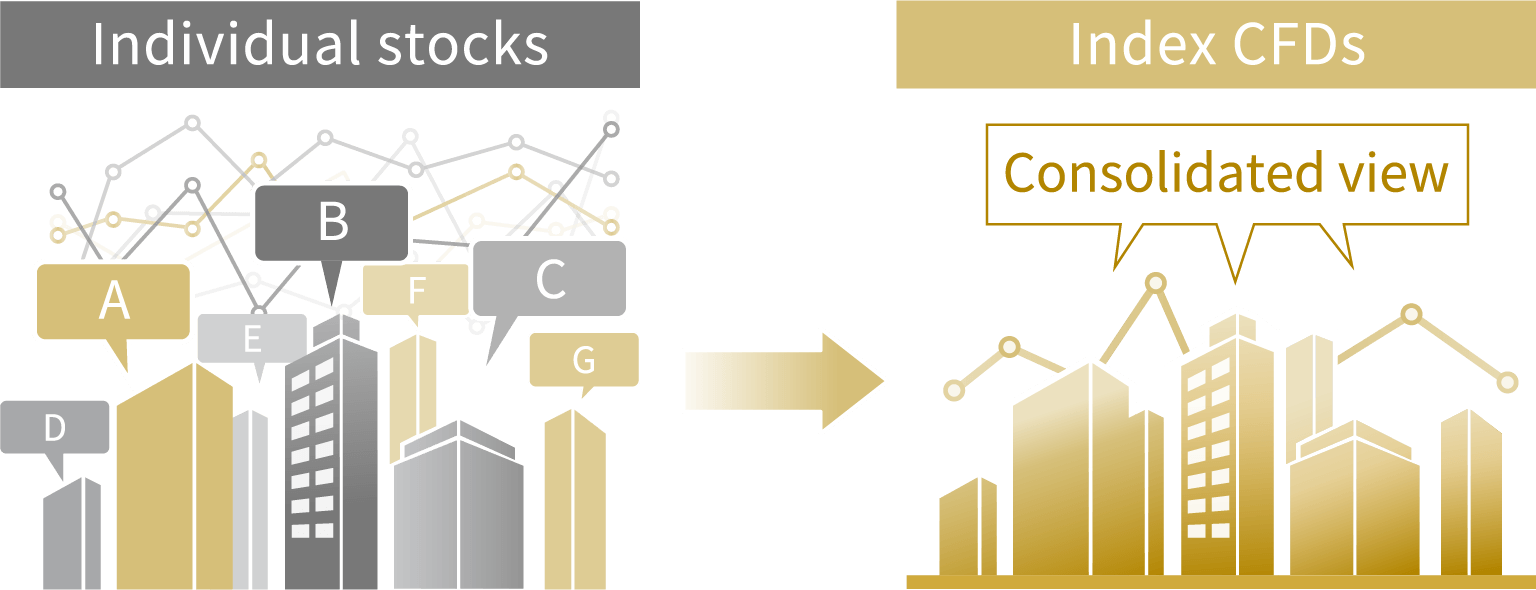
A stock index is a metric that quantifies the stock prices of multiple companies to reflect the overall market trend. It is used to gauge the performance and trends of the stock market as a whole, which can be difficult to discern from the movements of individual stock prices alone.For example, the JP225 (Nikkei 225) refers to an average stock price composed of 225 representative Japanese stocks, while the Dow Jones Industrial Average (US30) refers to an average stock price composed of 30 representative U.S. stocks. In this way, stock indices are regarded as important indicators that investors and traders use to analyze market trends and construct portfolios.
The Difference Between FX Currency Pairs and Stock Index CFDs
Both Exness’s FX currency pairs and stock index CFDs are trading methods that aim to generate profits by capitalizing on fluctuations in asset prices, but there is a significant difference in the underlying assets. While FX currency pairs are traded based on the exchange rates between different currencies, stock index CFDs are traded based on the prices of stock indices published by various exchanges.Furthermore, while FX currency pairs are susceptible to various factors such as national economic indicators, stock index CFDs are more influenced by overall economic trends and corporate performance. In addition, stock index CFDs tend to have higher volatility and are better suited for high-return trading. These differences in the underlying assets allow for trading in distinct market environments.Please review the features of stock index CFDs and enjoy your trading experience.
The Difference Between Stock CFDs and Stock Index CFDs
While Exness’s stock CFDs and stock index CFDs both involve trading based on corporate stock prices, the underlying assets differ. Stock CFDs are based on the shares of individual companies; at Exness, you can trade CFDs on 90 major companies listed on the U.S. stock market.On the other hand, stock index CFDs allow you to trade stock indices based on the shares of multiple companies. For example, Exness offers 10 major stock index CFDs from global stock markets, including the JP225 (Nikkei 225) and the Dow Jones Industrial Average (US30).
While stock CFDs depend on the performance of individual companies, stock index CFDs are based on indices comprising multiple companies; as such, they are influenced by the overall market performance and are characterized by diversified risk. Furthermore, since stock indices reflect trends in the stock market, you can apply your analysis of stock trading to your trading of stock index CFDs.
Trading Conditions for Exness Stock Index CFDs
To ensure you can trade Exness stock index CFDs with confidence, we have established several trading conditions. The trading conditions for Exness stock index CFDs are as follows.
Exness Stock Index CFD Trading Instruments
At Exness, you can trade a total of 10 stock index CFDs, including the JP225 (Nikkei 225) and the Dow Jones Industrial Average (US30).The key feature of stock index CFDs is that the stocks used to calculate each index are grouped by country. For example, since the JP225 (Nikkei 225) consists solely of stocks listed on the Japanese stock market (Tokyo Stock Exchange), it is significantly influenced by Japan’s economic conditions and market trends. Please pay close attention to economic indicators and statements by key figures in the country where the stocks you are trading are based.Furthermore, compared to FX currency pairs, stock index CFDs are relatively less affected by economic indicators from other countries, allowing you to trade based on simple fundamental analysis.
List of Exness Stock Index CFD Instruments
| Stock | Country | Constituent Stocks |
|
AUS200 (ASX 200) |
Australia | The Top 200 Stocks Listed on the Australian Securities Exchange |
|
DE30 (DAX) |
Germany | The 40 leading stocks listed on the Frankfurt Stock Exchange |
|
FR40 (CAC 40) |
France | 40 stocks listed on Euronext Paris |
|
HK50 (Hong Kong 50) |
Hong Kong | The Top 50 Stocks Listed on the Hong Kong Stock Exchange |
|
JP225 (Nikkei 225) |
Japan | The 225 leading stocks listed on the Tokyo Stock Exchange |
|
STOXX 50 (Eurostoxx 50) |
EU | The top 50 stocks by market capitalization on stock markets in France, Germany, the Netherlands, and other countries |
|
UK100 (UK 100) |
United Kingdom | The 100 Largest Companies Listed on the London Stock Exchange |
|
US30 (US Wall Street 30) |
United States | A total of 30 stocks listed on the New York Stock Exchange and the NASDAQ |
|
US500 (S&P 500) |
United States | The 500 leading companies listed on the New York Stock Exchange, NASDAQ, and other markets |
|
USTEC (NASDAQ-100) |
United States | The Top 100 Stocks on the Nasdaq (Excluding Financials) |
| AUS200 | |
| Country | Australia |
| Constituent Stocks | The Top 200 Stocks Listed on the Australian Securities Exchange |
| DE30 | |
| Country | Germany |
| Constituent Stocks | The 40 leading stocks listed on the Frankfurt Stock Exchange |
| FR40 | |
| Country | France |
| Constituent Stocks | 40 stocks listed on Euronext Paris |
| HK50 | |
| Country | Hong Kong |
| Constituent Stocks | The Top 50 Stocks Listed on the Hong Kong Stock Exchange |
| JP225 | |
| Country | Japan |
| Constituent Stocks | The 225 leading stocks listed on the Tokyo Stock Exchange |
| STOXX 50 | |
| Country | EU |
| Constituent Stocks | The top 50 stocks by market capitalization on stock markets in France, Germany, the Netherlands, and other countries |
| UK100 | |
| Country | United Kingdom |
| Constituent Stocks | The 100 Largest Companies Listed on the London Stock Exchange |
| US30 | |
| Country | United States |
| Constituent Stocks | A total of 30 stocks listed on the New York Stock Exchange and the NASDAQ |
| US500 | |
| Country | United States |
| Constituent Stocks | The 500 leading companies listed on the New York Stock Exchange, NASDAQ, and other markets |
| USTEC | |
| Country | United States |
| Constituent Stocks | The Top 100 Stocks on the Nasdaq (Excluding Financials) |
Exness Stock Index CFD Trading Hours
Exness’s stock index CFDs are available for trading from early Monday morning through early Saturday morning. Since financial markets around the world operate on different time zones, you can generally trade stock indices from various countries 24 hours a day on weekdays at any time that suits you.For example, you can trade the JP225 (Nikkei 225) and the Dow Jones Industrial Average (US30) after 3:30 PM, when the Tokyo Stock Exchange closes, or in the early morning Japan Standard Time when the New York market is closed. Even if you cannot set aside a fixed time on weekdays, you can use stock index CFDs to trade efficiently during your free time.However, there is a trading halt every morning for stock index CFDs, during which trading is not available. Please note that the AUS200 (ASX 200) and HK50 (Hong Kong 50) in particular have trading halts not only in the morning but also after noon.
In addition, price volatility in stock index CFDs varies depending on whether the exchange is open or closed. For example, when trading the JP225 (Nikkei 225), price movements tend to be more volatile around 9:00 a.m., when the Tokyo Stock Exchange opens and many companies begin their workday.Since price movements in stock index CFDs vary depending on the time of day, please familiarize yourself with the characteristics of stock index CFDs before trading.
Exness Stock Index CFD Trading Hours (Japan Time)
| Stock |
Summer Hours (Market Closure Hours) |
Winter Hours (Trading Suspension Hours) |
| AUS200 |
Mon 7:05 a.m.–Sat 5:00 a.m. (5:59 a.m.–7:05 a.m.) (2:30 p.m.–3:10 p.m.) |
Mon 8:05 a.m. – Sat 6:00 a.m. (6:59 a.m. – 8:05 a.m.) (2:30 p.m. – 3:10 p.m.) |
|
DE30 FR40 US30 US500 USTEC STOXX50 JP225 UK100 |
Mon 7:05 a.m. – Sat 5:00 a.m. (5:59 a.m. – 7:05 a.m.) |
Mon 8:05 a.m. – Sat 6:00 a.m. (6:59 a.m. – 8:05 a.m.) |
| HK50 |
Mon 7:05 a.m. – Sat 5:00 a.m . (9:45 a.m. – 10:14:59 a.m.) (1:30 p.m. – 1:59:59 p.m.) (5:30 p.m. – 6:14:59 p.m.) |
Mon 8:05 a.m. – Sat 6:00 a.m . (9:45 a.m. – 10:14:59 a.m.) (1:30 p.m. – 1:59:59 p.m.) (5:30 p.m. – 6:14:59 p.m.) |
| AUS200 | |
| Summer Hours (Market Closure Hours) |
Mon 7:05 a.m.–Sat 5:00 a.m. (5:59 a.m.–7:05 a.m.) (2:30 p.m.–3:10 p.m.) |
| Winter Hours (Trading Suspension Hours) |
Mon 8:05 a.m. – Sat 6:00 a.m. (6:59 a.m. – 8:05 a.m.) (2:30 p.m. – 3:10 p.m.) |
| DE30, FR40, US30, US500, USTEC, STOXX50, JP225, UK100 |
|
| Summer Hours (Market Closure Hours) |
Mon 7:05 a.m. – Sat 5:00 a.m. (5:59 a.m. – 7:05 a.m.) |
| Winter Hours (Trading Suspension Hours) |
Mon 8:05 a.m. – Sat 6:00 a.m. (6:59 a.m. – 8:05 a.m.) |
| HK50 | |
| Summer Hours (Market Closure Hours) |
Mon 7:05 a.m. – Sat 5:00 a.m . (9:45 a.m. – 10:14:59 a.m.) (1:30 p.m. – 1:59:59 p.m.) (5:30 p.m. – 6:14:59 p.m.) |
| Winter Hours (Trading Suspension Hours) |
Mon 8:05 a.m. – Sat 6:00 a.m . (9:45 a.m. – 10:14:59 a.m.) (1:30 p.m. – 1:59:59 p.m.) (5:30 p.m. – 6:14:59 p.m.) |

Exness observes U.S. Daylight Saving Time, so trading hours vary by approximately one hour between “Daylight Saving Time” and “Standard Time.”Please note that Exness’s server time is set to Greenwich Mean Time (GMT+0), resulting in a time difference of +9 hours compared to Japan. Therefore, you can convert the time displayed on MT4 (MetaTrader 4) or MT5 (MetaTrader 5) to Japan time by adding 9 hours.
Leverage on Exness Stock Index CFDs
With Exness’s stock index CFDs, you can utilize leverage ranging from 200x to 400x. High leverage allows you to execute large trades with a small amount of capital, enabling you to trade stock index CFDs efficiently and aim for profits while minimizing risk.Furthermore, since stock index CFDs tend to be more volatile than FX, high leverage can be advantageous and make it easier to generate profits. However, high-leverage trading can also result in significant losses due to sudden market fluctuations, so risk management is crucial. Please select an appropriate leverage level based on your own risk tolerance.
Leverage on Exness Stock Index CFDs
| Products | Leverage |
| US30, US500, USTEC |
400 times |
| Other Indexes |
200 times |

Exness Stock Index CFD Spreads
At Exness, we offer some of the narrowest spreads in the industry, starting at just 0.0 pips.Since spreads represent a cost incurred with every trade, narrower spreads are more advantageous for traders and have a positive impact on trading results. In particular, traders who use strategies involving frequent, short-term trades—such as scalping—can minimize their trading costs by selecting instruments with low spreads.Please note that while Exness offers fixed spreads on major currency pairs, gold, and silver, stock index CFDs use variable spreads, and spread values vary by instrument and account type.
List of Average Spreads for Exness Stock Index CFDs
| Stock | Standard Account | Low-Spread Account | Zero Account | Pro Account |
|
AUS200 (Australia S&P ASX 200 Index) |
||||
|
DE30 (Germany 30 Index) |
||||
|
FR40 (France 40 Index) |
|
HK50 (Hong Kong 50 Index) |
||||
|
JP225 (Japan 225 Index) |
||||
|
STOXX 50 (EU Stocks 50 Index) |
||||
|
UK100 (UK 100 Index) |
||||
|
US30 (US Wall Street Index 30) |
||||
|
US500 (US SPX 500 Index) |
||||
|
USTEC (US Tech 100 Index) |
| AUS200 | |
| Standard Account | |
| Low-Spread Account | |
| Zero Account | |
| Pro Account | |
| DE30 | |
| Standard Account | |
| Low-Spread Account | |
| Zero Account | |
| Pro Account | |
| FR40 | |
| Standard Account | |
| Low-Spread Account | |
| Zero Account | |
| Pro Account | |
| HK50 | |
| Standard Account | |
| Low-Spread Account | |
| Zero Account | |
| Pro Account | |
| JP225 | |
| Standard Account | |
| Low-Spread Account | |
| Zero Account | |
| Pro Account | |
| STOXX 50 | |
| Standard Account | |
| Low-Spread Account | |
| Zero Account | |
| Pro Account | |
| UK100 | |
| Standard Account | |
| Low-Spread Account | |
| Zero Account | |
| Pro Account | |
| US30 | |
| Standard Account | |
| Low-Spread Account | |
| Zero Account | |
| Pro Account | |
| US500 | |
| Standard Account | |
| Low-Spread Account | |
| Zero Account | |
| Pro Account | |
| USTEC | |
| Standard Account | |
| Low-Spread Account | |
| Zero Account | |
| Pro Account | |
Exness Stock Index CFD Swap Points
At Exness, you can trade all stock index CFDs on a swap-free basis. Swap-free means that no rollover fees—which arise from interest rate differentials when positions are carried over to the next day—are charged.At Exness, the swap-free feature is applied by default to all account types, allowing you to eliminate trading costs associated with negative swaps even when holding positions for extended periods. Since the swap points for stock index CFDs offered by Exness rarely result in positive swaps, you can take advantage of the swap-free feature to keep trading costs low while enjoying efficient trading.
However, if the intraday trading volume in your trading account decreases, the swap-free status may be revoked. If the swap-free status is revoked, swap points will be charged at the rollover time of 7:00 a.m. (6:00 a.m. during daylight saving time) each day. Please check your Exness Personal Area to confirm whether the swap-free status is active.Exness’s stock index CFD swap points are as follows:
List of Swap Points for Exness Stock Index CFDs
| Stock |
Swap Points (Long Position) |
Swap Points (Short/Sell) |
|
AUS200 (Australia S&P ASX 200) |
||
|
DE30 (Germany 30) |
||
|
FR40 (France 40) |
|
HK50 (Hong Kong 50) |
||
|
JP225 (Japan 225) |
||
|
STOXX 50 (EU Stocks 50) |
||
|
UK100 (UK 100) |
||
|
US30 (US Wall Street Index 30) |
||
|
US500 (US SPX 500) |
||
|
USTEC (US Tech 100) |
| AUS200 | |
Swap Points (Long Position) |
|
Swap Points (Short/Sell) |
|
| DE30 | |
Swap Points (Long Position) |
|
Swap Points (Short/Sell) |
|
| FR40 | |
Swap Points (Long Position) |
|
Swap Points (Short Position) |
|
| HK50 | |
Swap Points (Long Position) |
|
Swap Points (Short/Sell) |
|
| JP225 | |
Swap Points (Long Position) |
|
Swap Points (Short/Sell) |
|
| STOXX 50 | |
Swap Points (Long Position) |
|
Swap Points (Short Position) |
|
| UK100 | |
Swap Points (Long Position) |
|
Swap Points (Short Position) |
|
| US30 | |
Swap Points (Long Position) |
|
Swap Points (Short Position) |
|
| US500 | |
Swap Points (Long Position) |
|
Swap Points (Short Position) |
|
| USTEC | |
Swap Points (Long Position) |
|
Swap Points (Short Position) |
|
Benefits of Trading Exness Stock Index CFDs
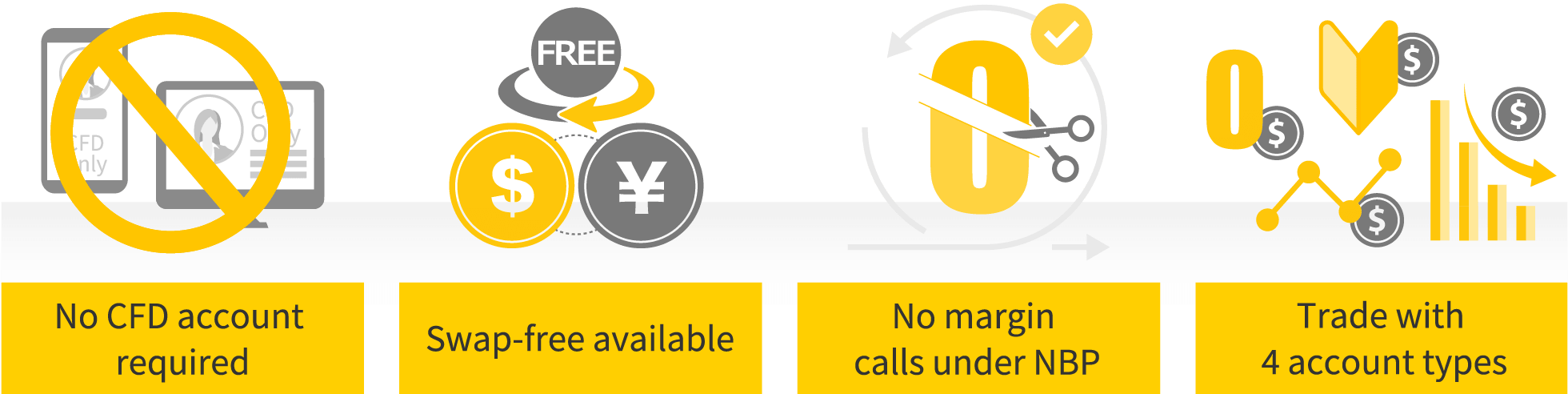
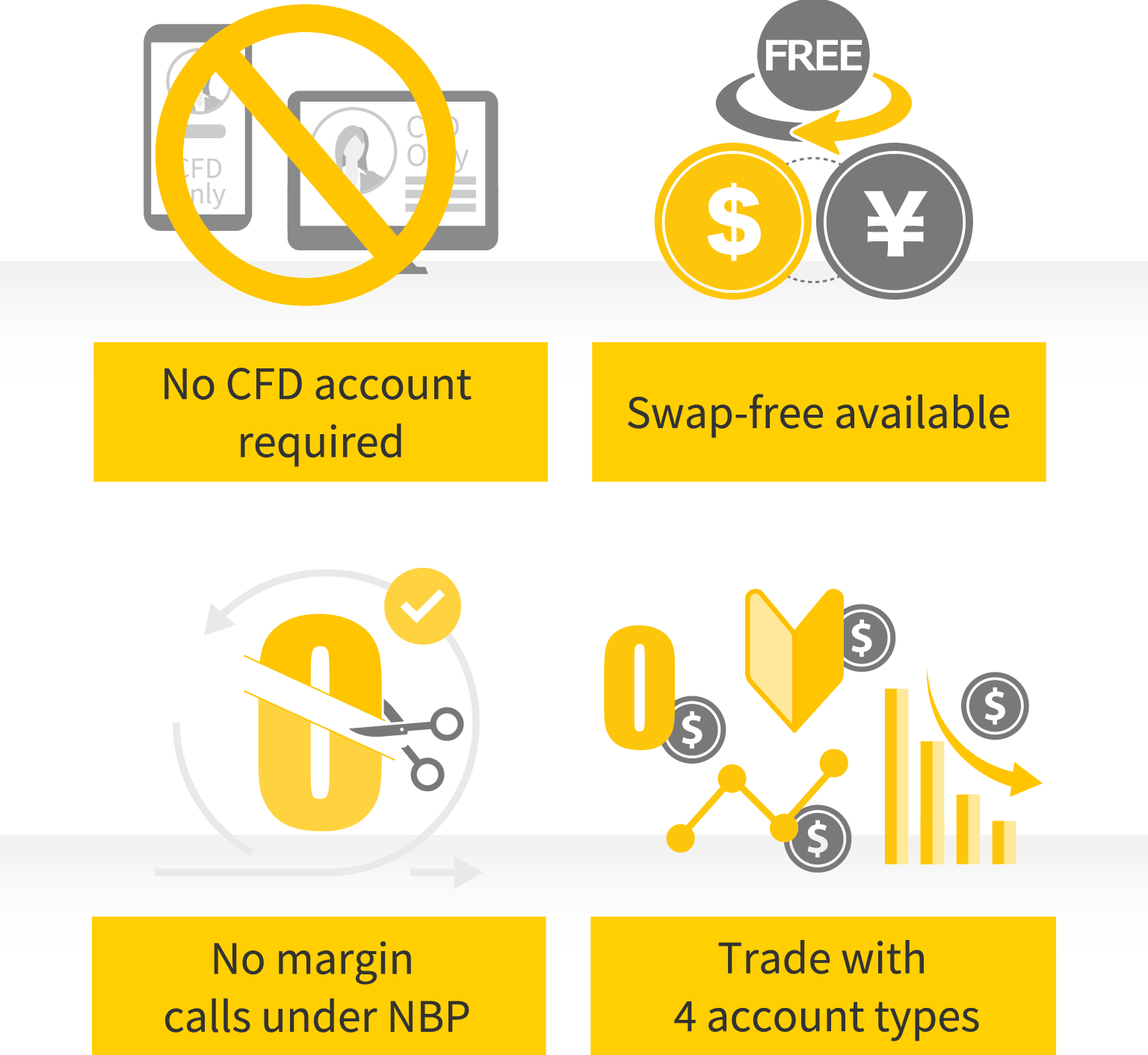
The stock index CFDs offered by Exness come with a variety of benefits, including high leverage of up to 400x (*) and low trading costs. Since you can trade stock index CFDs without opening a dedicated account, we invite you to take full advantage of these benefits and enjoy trading stock index CFDs with Exness.
(*) Leveraged trading involves high risk, and you may lose all of your invested capital. Please ensure you fully understand the risks before trading.
No need to open a dedicated CFD account
At Exness, you don’t need to open a separate CFD account; you can trade FX currency pairs and stock index CFDs using a single account. While some FX brokers require you to open a dedicated CFD account, Exness eliminates the need for a separate account, reducing the hassle of getting started and allowing you to begin trading smoothly.Not needing a separate CFD account shortens the time it takes to start trading and allows for seamless account and fund management. Additionally, since you can trade multiple financial instruments from the same trading account, your trading options expand, enabling efficient and flexible trading. If you don’t yet have an Exness account, take this opportunity to open one and enjoy trading stock index CFDs.
Trade stock index CFDs with minimal transaction costs
Exness’s stock index CFDs allow you to trade efficiently with minimal transaction costs.With some of the narrowest spreads in the industry, Exness allows you to keep your total trading costs low even after factoring in trading commissions, so you can keep more of your profits. Furthermore, Exness’s stock index CFDs are swap-free, so you don’t have to worry about trading costs from negative swaps even if you hold positions for extended periods.Furthermore, since Exness charges no deposit, withdrawal, or account maintenance fees, you can keep your trading costs to a minimum. Exness offers favorable conditions for our clients not only in terms of the trading environment but also in terms of trading costs, so you can enjoy trading stock index CFDs with peace of mind.
No margin calls thanks to the zero-cut system
At Exness, we employ the Zero Cut System for all account types and all tradable instruments. The Zero Cut System is a mechanism that resets your account balance to zero when losses exceed your account balance due to sudden market fluctuations. Since Exness covers the negative balance, you are not required to pay a margin call (additional margin).Since stock index CFDs are also covered by the zero-cut system, you can enjoy dynamic trading without worrying about losses exceeding your deposited funds.
You can trade using four different account types
Exness’s stock index CFDs are available for trading across four account types: “Standard Account,” “Low Spread Account,” “Zero Account,” and “Pro Account.” The Standard Account is a popular choice among traders of all levels, from beginners to advanced, and allows you to trade with no transaction fees even with a small amount of capital.This account type is recommended for those who want to try trading stock index CFDs with a small amount of capital.If you want to trade stock index CFDs while keeping trading costs low with spreads starting at 0 pips, we recommend the Low Spread Account, Zero Account, or Pro Account—all of which are professional-grade options. Since trading conditions vary by account type, choosing the one that best suits your trading style will help you aim to generate profits more effectively through stock index CFDs.Please note that the “Standard Cent Account” does not support stock index CFDs. If you wish to trade stock index CFDs, please open an additional account of a different type. You can easily open up to 200 additional Exness accounts via your Personal Area or the Exness Trading App.
Dividend Adjustments for Exness Stock Index CFDs
With Exness’s stock index CFDs, you are eligible for dividend adjustments even if you do not hold the underlying stocks. Please review how dividend adjustments work for Exness’s stock index CFDs and enjoy trading.
What Is a Dividend Adjustment?
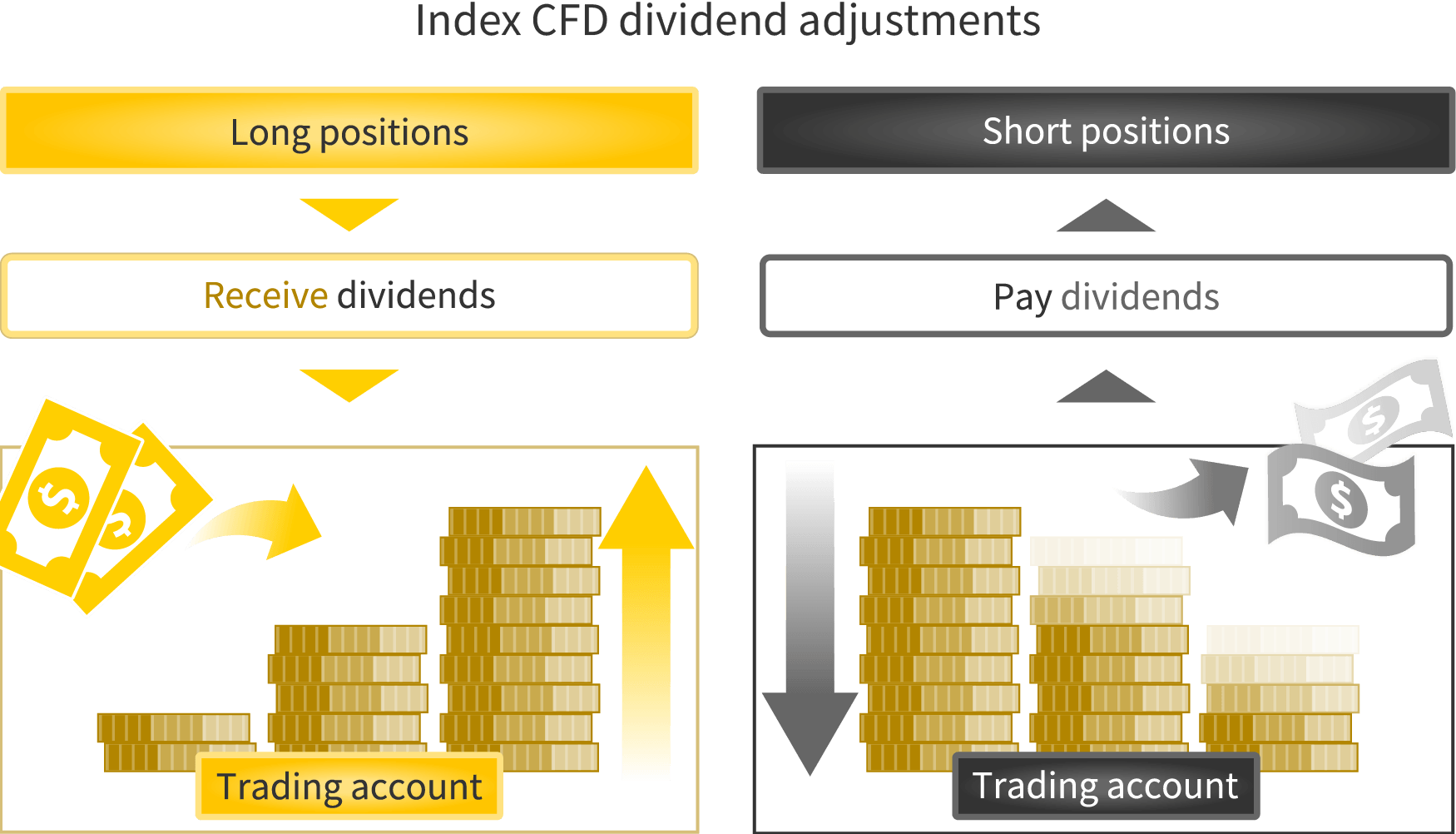
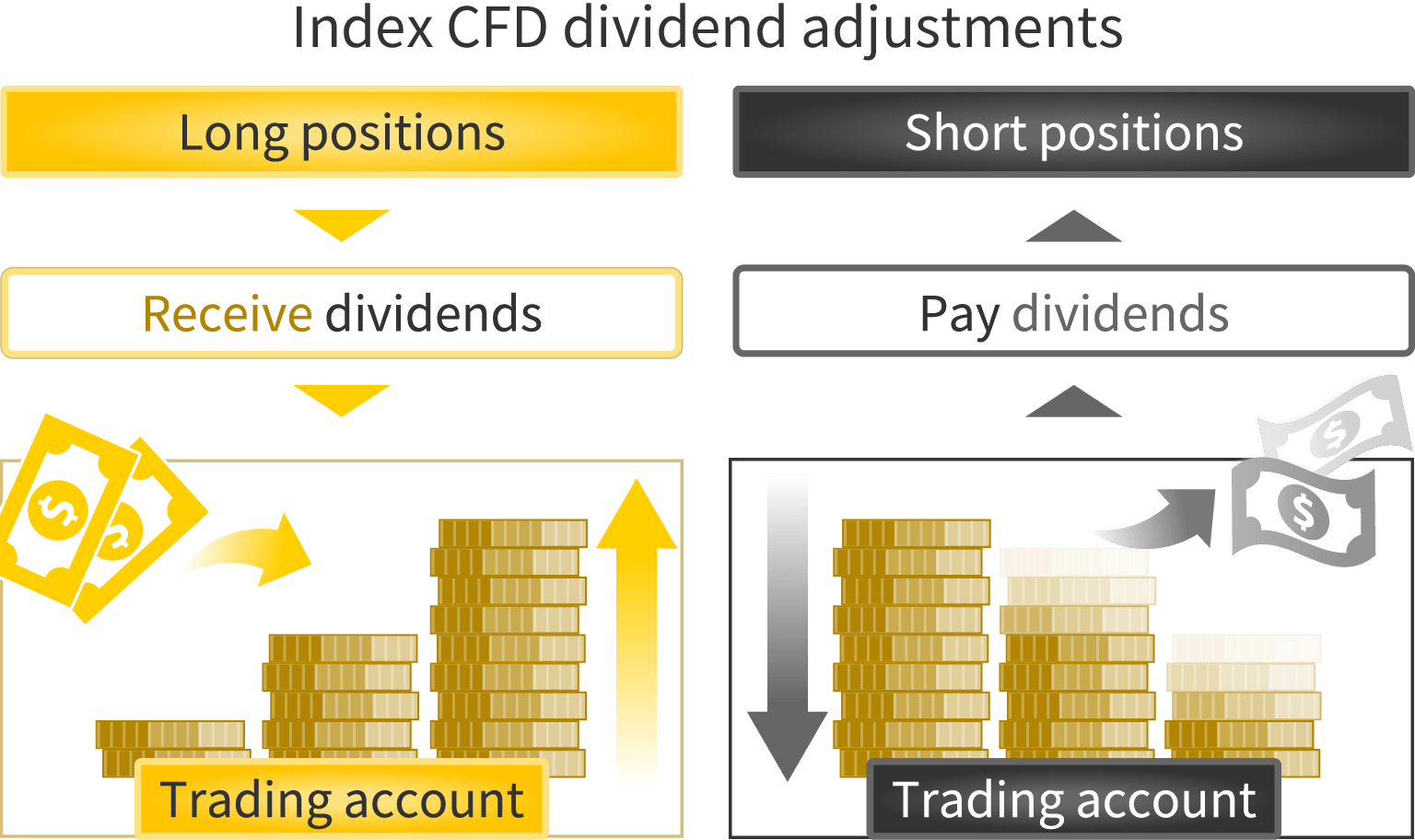
With Exness’s stock index CFDs, an amount equivalent to the dividends distributed to shareholders in stock trading is reflected in your trading account as a dividend adjustment. Since Exness CFD trading does not involve holding the actual shares, the system is designed to reflect this amount to traders as a dividend adjustment rather than as a dividend payment.It is important to note that depending on the direction of your position, you may either receive or pay a dividend adjustment. Specifically, for a long position, it is added to your profit, while for a short position, it is subtracted from your profit.
Timing of Dividend Adjustments for Exness Stock Index CFDs
At Exness, dividend adjustments are made to coincide with the actual timing when shareholders receive their dividends. These adjustments are reflected at the start of trading hours for stock index CFDs. While trading start times vary by stock index CFD, dividend adjustments are reflected in trading balances early in the morning (Japan Standard Time) for all of them.
How Exness Calculates Dividend Adjustments for Stock Index CFDs
At Exness, dividend adjustments—calculated based on the trading volume and dividend yield of your open stock index CFD positions—are reflected in your trading account. Please note that while you will receive dividend adjustments on long positions, you will be required to pay them on short positions, so please manage your positions carefully.The calculation method for dividend adjustments on Exness stock index CFDs is as follows.
Dividend Adjustment = Lots × Contract Size × Dividend Rate
If you would like to view details regarding dividend adjustments, please select “Dividends” from the “Performance” tab in your Personal Area.
Important Notes on Exness Stock Index CFDs
There are several important points to keep in mind when trading stock index CFDs on Exness. Please review these points carefully before trading.
Volatility tends to increase
When trading stock index CFDs on Exness, you should exercise caution because volatility (price fluctuations) tends to be high. Volatility fluctuates depending on market liquidity. Specifically, markets with high liquidity tend to have lower volatility and smaller price movements.Conversely, in markets with low liquidity, volatility is high, and prices can fluctuate significantly in a short period of time. Since the stocks and indices traded as CFDs generally have lower liquidity compared to FX currency pairs, they tend to exhibit higher volatility.
In addition, since stock index CFD markets are susceptible to the influence of economic and political factors in various countries, as well as corporate earnings, sharp price fluctuations may occur following major announcements. Therefore, please trade with the understanding that there is a risk that market movements could be more significant than anticipated.In particular, during periods of heightened volatility, trading with leverage can pose significant risks; therefore, it is crucial to implement appropriate risk management strategies, such as stop-loss and take-profit orders. By understanding the volatility of each specific index and responding appropriately, you can trade Exness stock index CFDs more effectively.
Subject to Leverage Limits
Exness’s stock index CFDs are subject to leverage restrictions, so leverage ranging from 200x to 400x is applied, and you cannot trade with leverage of up to 2,000x.While the inability to use up to 2,000x leverage makes it easier to manage risk and prevent trading losses, it also makes it difficult to hold large positions with limited capital.However, since Exness’s stock index CFDs tend to be high-risk, high-return trades with greater volatility compared to FX, we have implemented leverage levels that minimize the risk of losing your entire margin in a short period of time.If you wish to trade with Exness’s maximum leverage of 2,000x (*), please enjoy trading major currency pairs, minor currency pairs, and precious metals (gold and silver).
(*) Leveraged trading involves high risk, and you may lose all of your invested capital. Please ensure you fully understand the risks before trading.
Low-spread and zero-commission accounts incur trading fees
Exness’s Low Spread accounts incur trading fees of 0–3.5 USD per side, while Zero accounts incur fees of 0.5–4.25 USD (equivalent).While both account types incur trading fees, they offer ultra-tight spreads starting at 0 pips, allowing you to keep your overall trading costs low even when factoring in these fees. Please select the account type that best suits your trading style.Please note that trading fees for stock index CFDs vary between the Low Spread and Zero accounts depending on the specific instrument, so please check in advance. With Exness’s Standard and Pro accounts, you can trade stock index CFDs with no trading fees.
Trading is not available during trading halts.
Please note that trading in Exness stock index CFDs is not available during trading halts. Trading halts occur during specific periods in the early morning and afternoon, during which trading is temporarily suspended, and you cannot execute new orders or modify positions. Trading halt times vary by stock index CFD instrument, so please check them in advance.Please also note that chart updates are suspended during trading halts, so you will not be able to monitor market movements in real time. When trading, we recommend planning your trades carefully—either by scheduling trades to avoid these periods or by closing out positions before the trading halt begins.
Frequently Asked Questions (FAQ) About Exness Stock Index CFDs
-
Can I receive dividends on Exness stock index CFDs?
Yes, with Exness’s stock index CFDs, you can receive dividends (dividend adjustments). When trading stock indices on Exness, while you cannot directly receive dividends paid by companies to their shareholders, an amount equivalent to the dividends is credited to your trading account as a dividend adjustment.
Read More
28.01.2025
-
Are Exness stock index CFDs swap-free?
Yes, all stock index CFDs on Exness are swap-free. Since Exness applies swap-free trading by default to all account types, you can eliminate trading costs associated with negative swaps even when holding positions for extended periods.
Read More
28.01.2025
-
Please tell me the trading hours for Exness's stock index CFDs.
Trading hours for Exness stock index CFDs run from early Monday morning through early Saturday morning. Since financial markets around the world open at different times, you can generally trade stock indices from various countries 24 hours a day on weekdays, at any time that suits you. However, please note that there is a trading halt each morning for certain instruments, so please check the trading hours in advance.
Read More
28.01.2025
-
Please tell me which account types allow me to trade stock index CFDs on Exness.
You can trade Exness stock index CFDs using one of four account types: Standard, Low Spread, Zero, and Pro. Trading conditions vary by account type, so please choose the account type that best suits your trading style.
Read More
28.01.2025