














Exness Trading Hours
Transaction
Exness Trading Hours
Exness is open for trading from early Monday morning through early Saturday morning, excluding maintenance periods. Please note that trading is not available or has reduced hours on weekends and global holidays such as the year-end and New Year’s holidays and Christmas.
At Exness, you can trade not only FX currency pairs but also popular assets such as gold and silver, as well as energy, stocks, stock indices, and cryptocurrencies via CFDs. Trading hours vary by instrument, so please check them in advance before you begin trading.Please note that cryptocurrency CFDs can be traded 24 hours a day, 365 days a year. With a wide variety of instruments—each with its own market characteristics and optimal trading times—you can enjoy trading with Exness whenever it suits you best.
Exness Trading Hours Policy
Exness’s trading hours are from early Monday morning to early Saturday morning, and you can trade almost 24 hours a day, except during server maintenance. However, trading hours vary by instrument, so please check them in advance before you start trading. Please note that cryptocurrency CFDs can be traded 24 hours a day, 365 days a year.
At Exness, trading is either unavailable or trading hours are shortened on weekends—when most major global markets are closed—as well as on global holidays such as the year-end and New Year’s holidays and Christmas. During these times, you cannot place or settle orders using limit orders or EAs (automated trading systems).Please also note that since Exness operates on U.S. Daylight Saving Time, trading hours may vary by approximately one hour between summer and winter.
Exness Trading Hours During Daylight Saving Time and Standard Time
Exness observes daylight saving time, so there are “summer time” and “winter time” trading hours.Daylight saving time is a system, primarily used in Europe, North America, and Oceania, in which clocks are set forward one hour during the spring and fall months when daylight hours are longer. It is implemented by countries or states to shift daily routines and business activities earlier during periods when the sun rises earlier, with the aim of making effective use of daylight hours.
In the spring, countries that observe daylight saving time switch to summer time, which means that the opening and closing times of foreign exchange markets in those countries are moved up. Exness applies “summer time” and “winter time” during the periods listed below.
Exness Daylight Saving Time and Standard Time Periods and Trading Hours
| Effective Period | Trading Hours | |
| Daylight Saving Time | The second Sunday in March through the first Sunday in November | Monday 6:05 a.m. – Saturday 5:59 a.m. |
| Standard Time | The first Sunday in November through the second Sunday in March | Monday 7:05 a.m. – Saturday 6:59 a.m. |
| Daylight Saving Time | |
| Effective Period | From the second Sunday in March to the first Sunday in November |
| Trading Hours | Monday 6:05 a.m. – Saturday 5:59 a.m. |
| Standard Time | |
| Effective Period | From the first Sunday in November to the second Sunday in March |
| Trading Hours | Monday 7:05 a.m. – Saturday 6:59 a.m. |
Please note that Exness will send a notification regarding the switch to daylight saving time to the email address you have registered in your Personal Area. This information is also available in the “News Topics” section, so please check there as needed.
Exness Christmas and Year-End/New Year Trading Hours
At Exness, trading may be suspended or trading hours may be shortened during global holidays such as Christmas and the New Year, as many markets—particularly in major countries—are closed during these periods.Around Christmas and the New Year, the number of market participants decreases significantly, leading to a sharp drop in liquidity. Since this makes the market prone to sudden price fluctuations and widening spreads, you should exercise caution when trading or holding positions overnight during this period.
Exness will send a notice regarding changes to trading hours during the Christmas and New Year’s holidays to the email address you have registered in your Personal Area. This information is also available under “News Topics,” so please be sure to check it and take appropriate precautions regarding your trading and any open positions.
Time Display on Exness MT4/MT5
Exness’s trading platforms, MT4 (MetaTrader 4) and MT5 (MetaTrader 5), display times in Greenwich Mean Time (GMT+0).Since Japan is 9 hours behind Greenwich Mean Time, you can convert the times displayed on MT4/MT5 to Japan Standard Time by adding 9 hours.
Please note that Exness's MT4/MT5 platforms observe daylight saving time, so the time difference is 9 hours regardless of whether it is summer or winter time.
Time Difference Between Exness MT4/MT5 Display Time and Japan Standard Time
| Daylight Saving Time / Standard Time (GMT+0) | Time difference from Japan: 9 hours (add 9 hours to the time displayed on MT4/MT5) |
Trading Hours for All Exness Instruments (Japan Time)
With Exness, you can generally trade almost 24 hours a day, from early Monday morning to early Saturday morning, except during maintenance periods. However, please note that trading hours vary by instrument for certain FX currency pairs, as well as CFDs on precious metals, energy, stocks, and stock indices.Furthermore, cryptocurrency CFDs can be traded 24 hours a day, 365 days a year, including weekends—when most markets are closed—as well as Christmas and the year-end and New Year holidays.
Trading Hours for Exness FX Currency Pairs
The trading hours for Exness’s FX currency pairs are as follows.However, trading hours differ for USD/CNH (U.S. Dollar/Chinese Yuan), USD/THB (U.S. Dollar/Thai Baht), USD/ILS (U.S. Dollar/New Shekel), and GBP/ILS (British Pound/New Shekel).Please also note that while FX currency pairs can be traded from early Monday morning through early Saturday morning, trading in certain instruments is suspended for a set period each day.
| Stock | Summer Hours (Market Closure Hours) |
Winter Hours (Trading Suspension Hours) |
| FX currency pairs (excluding the four listed below) |
Mon 6:05 a.m. – Sat 5:59 a.m. | Mon 7:05 a.m. – Sat 6:59 a.m. |
| USD/CNH USD/THB |
Mon 8:05 a.m. – Sat 5:59 a.m. | Mon 9:05 a.m. – Sat 6:59 a.m. |
| USD/ILS GBP/ILS |
Mon 2:00 PM – Sat 12:00 AM (12:00 AM – 2:00 PM) |
Mon 3:00 PM – Sat 1:00 AM (1:00 AM – 3:00 PM) |
| FX currency pairs (excluding the four listed below) | |
| Daylight Saving Time | Mon 6:05 a.m. – Sat 5:59 a.m. |
| Standard Time | Mon 7:05 a.m. – Sat 6:59 a.m. |
| USD/CNH USD/THB | |
| Daylight Saving Time | Mon 8:05 a.m. – Sat 5:59 a.m. |
| Standard Time | Mon 9:05 a.m. – Sat 6:59 a.m. |
| USD/ILS GBP/ILS | |
| Daylight Saving Time | Mon 2:00 PM – Sat 12:00 AM (12:00 AM – 2:00 PM) (*) |
| Standard Time | Mon 3:00 PM – Sat 1:00 AM (1:00 AM – 3:00 PM) (*) |
(*) Trading Suspension Period
Trading Hours for Exness Precious Metals CFDs
At Exness, you can trade four types of precious metals—gold, silver, palladium, and platinum—via CFDs.Among the precious metal CFDs, trading for gold and silver begins 5 minutes earlier than for palladium and platinum. Please note that while precious metal CFDs can be traded from early Monday morning through early Saturday morning, there is a trading suspension period every morning.
| Stock | Summer Hours (Market Closure Hours) |
Winter Hours (Trading Suspension Hours) |
| XAG (Silver) XAU (Gold) |
Mon 7:05 a.m. – Sat 5:59 a.m. (5:59 a.m. – 7:01 a.m.) |
Mon 8:05 a.m. – Sat 6:59 a.m. (6:59 a.m. – 8:01 a.m.) |
| XPD (Palladium) XPT (Platinum) |
Mon 7:10 a.m. – Sat 5:59 a.m. (5:59 a.m. – 7:05 a.m.) |
Mon 8:10 a.m. – Sat 6:59 a.m. (6:59 a.m. – 8:05 a.m.) |
| XAG XAU | |
| Summer Hours (Market Closure Hours) |
Mon 7:05 a.m. – Sat 5:59 a.m. (5:59 a.m. – 7:01 a.m.) |
| Winter Hours (Trading Suspension Hours) |
Mon 8:05 a.m. – Sat 6:59 a.m. (6:59 a.m. – 8:01 a.m.) |
| XPD XPT | |
| Summer Hours (Market Closure Hours) |
Mon 7:10 a.m. – Sat 5:59 a.m. (5:59 a.m. – 7:05 a.m.) |
| Winter Hours (Trading Suspension Hours) |
Mon 8:10 a.m. – Sat 6:59 a.m. (6:59 a.m. – 8:05 a.m.) |
Trading Hours for Exness Energy CFDs
At Exness, you can trade energy products such as Brent crude oil, crude oil, and natural gas via CFDs.Among our energy CFDs, trading for Brent Crude and Crude Oil begins two hours earlier and ends five minutes earlier than for Natural Gas. Please note that while energy CFDs can be traded from early Monday morning through early Saturday morning, there is a trading halt every morning.
| Stock | Summer Hours (Market Closure Hours) |
Winter Hours (Trading Suspension Hours) |
| UKOIL (Brent Crude) USOIL (Crude Oil) |
Mon 7:10 a.m. – Sat 5:45 a.m. (5:45 a.m. – 7:10 a.m.) |
Mon–Fri 8:10 a.m.–Sat 6:45 a.m. (6:45 a.m.–8:10 a.m.) |
| XNGUSD (Natural Gas) | Mon 9:10 a.m. – Sat 5:55 a.m. (5:55 a.m. – 9:10 a.m.) |
Mon 10:10 a.m. – Sat 6:55 a.m. (6:55 a.m. – 10:10 a.m.) |
| UKOIL USOIL | |
| Summer Hours (Market Closure Hours) |
Mon 7:10 a.m. – Sat 5:45 a.m. (5:45 a.m. – 7:10 a.m.) |
| Winter Hours (Trading Suspension Hours) |
Mon–Fri 8:10 a.m.–Sat 6:45 a.m. (6:45 a.m.–8:10 a.m.) |
| XNGUSD | |
| Summer Hours (Market Closure Hours) |
Mon 9:10 a.m. – Sat 5:55 a.m. (5:55 a.m. – 9:10 a.m.) |
| Winter Hours (Trading Suspension Hours) |
Mon 10:10 a.m. – Sat 6:55 a.m. (6:55 a.m. – 10:10 a.m.) |
Exness Stock CFD Trading Hours
At Exness, you can trade CFDs on stocks listed on the U.S. stock market. Trading hours for stock CFDs are from Monday evening through early Saturday morning for all securities; however, please note that trading is not available during the early morning to late evening hours in Japan when the U.S. stock market is closed.However, for certain stocks, only orders to close open positions may be placed during the pre-market (after-hours trading) session from 7:00 PM to 10:40 PM.
| Stock | Summer Hours (Market Closure Hours) |
Winter Hours (Trading Suspension Hours) |
| Stock CFDs | Mon–Fri 10:40 p.m.–4:45 a.m. the following day (4:45 a.m.–10:40 p.m.) |
Mon–Fri 11:40 p.m.–5:45 a.m. the following day (5:45 a.m.–11:40 p.m.) |
| Stock CFDs | |
| Summer Hours (Market Closure Hours) |
Mon–Fri 10:40 p.m.–4:45 a.m. the following day (4:45 a.m.–10:40 p.m.) |
| Winter Hours (Trading Suspension Hours) |
Mon–Fri 11:40 p.m.–5:45 a.m. the following day (5:45 a.m.–11:40 p.m.) |
Stocks Available for Pre-Market Trading
INTC, BAC, TSLA, WFC, BABA, NFLX, C, AMD, PFE, META, JNJ,PYPL, ORCL, NVDA, MSFT, AMZN, AAPL, BA, BEKE, BIDU, BILI, FTNT, JD, LI, NIO, NTES, PDD, TAL, TSM, XPEV, AMC, BB, BYND, FUTU, TIGR

"Pre-market" refers to after-hours trading that takes place before the regular trading hours of the U.S. stock market. Since trading occurs when the U.S. stock market is closed, trading volume may be lower and volatility may be higher compared to regular trading hours.
Trading Hours for Exness Stock Index CFDs
At Exness, you can trade major global stock indices via CFDs.Stock index CFDs can be traded from early Monday morning through early Saturday morning, but there is a trading halt every morning during which trading is not available. Please note that the AUS200 (ASX 200) and HK50 (Hong Kong 50) have trading halts not only in the morning but also in the afternoon.
| Stock | Summer Hours (Market Closure Hours) |
Winter Hours (Trading Suspension Hours) |
| AUS200 | Mon 7:05 a.m.–Sat 5:00 a.m. (5:59 a.m.–7:05 a.m.) (2:30 p.m.–3:10 p.m.) |
Mon 8:05 a.m. – Sat 6:00 a.m. (6:59 a.m. – 8:05 a.m.) (2:30 p.m. – 3:10 p.m.) |
| DE30 FR40 UK100 US30 US500 USTEC STOXX50 JP225 |
Mon 7:05 a.m. – Sat 5:00 a.m. (5:59 a.m. – 7:05 a.m.) |
Mon 8:05 a.m. – Sat 6:00 a.m. (6:59 a.m. – 8:05 a.m.) |
| HK50 | Mon 7:05 a.m. – Sat 5:00 a.m . (9:45 a.m. – 10:14:59 a.m.) (1:30 p.m. – 1:59:59 p.m.) (5:30 p.m. – 6:14:59 p.m.) |
Mon 8:05 a.m. – Sat 6:00 a.m . (9:45 a.m. – 10:14:59 a.m.) (1:30 p.m. – 1:59:59 p.m.) (5:30 p.m. – 6:14:59 p.m.) |
| AUS200 | |
| Summer Hours (Market Closure Hours) |
Mon 7:05 a.m.–Sat 5:00 a.m. (5:59 a.m.–7:05 a.m.) (2:30 p.m.–3:10 p.m.) |
| Winter Hours (Trading Suspension Hours) |
Mon 8:05 a.m. – Sat 6:00 a.m. (6:59 a.m. – 8:05 a.m.) (2:30 p.m. – 3:10 p.m.) |
| DE30 FR40 UK100 US30 US500 USTEC STOXX50 JP225 |
|
| Summer Hours (Market Closure Hours) |
Mon 7:05 a.m. – Sat 5:00 a.m. (5:59 a.m. – 7:05 a.m.) |
| Winter Hours (Trading Suspension Hours) |
Mon 8:05 a.m. – Sat 6:00 a.m. (6:59 a.m. – 8:05 a.m.) |
| HK50 | |
| Summer Hours (Market Closure Hours) |
Mon 7:05 a.m. – Sat 5:00 a.m . (9:45 a.m. – 10:14:59 a.m.) (1:30 p.m. – 1:59:59 p.m.) (5:30 p.m. – 6:14:59 p.m.) |
| Winter Hours (Trading Suspension Hours) |
Mon 8:05 a.m. – Sat 6:00 a.m . (9:45 a.m. – 10:14:59 a.m.) (1:30 p.m. – 1:59:59 p.m.) (5:30 p.m. – 6:14:59 p.m.) |
Exness Cryptocurrency CFD Trading Hours
At Exness, you can trade cryptocurrencies—including BTC (Bitcoin) and ETH (Ethereum)—as CFDs 24 hours a day, 365 days a year.Even on weekends—when FX currency pairs and other CFD instruments are closed—as well as during global holidays such as Christmas and the New Year, you can trade Exness’s cryptocurrency CFDs at any time.
However, you will not be able to trade while Exness is performing server maintenance. When server maintenance is scheduled, we will send advance notice to the email address you have registered in your Personal Area.
Major Markets and Characteristics of Exness Trading Hours
At Exness, you can trade 24 hours a day, from early Monday morning through early Saturday morning, excluding weekends, Christmas, and the New Year’s holiday period. However, since the primary foreign exchange market varies throughout the day, market conditions differ depending on the trading session.
Understand the characteristics of different trading hours—such as “times when trends are likely to emerge or reverse” and “times when spreads tend to widen”—and use this knowledge to execute efficient, strategic trades while minimizing losses.
Trading Hours in Major Countries
The foreign exchange market is often referred to as the “market that never sleeps” because trading is possible 24 hours a day. Although it is called a “market,” the foreign exchange market does not have a centralized exchange like the stock market. The time periods centered around business hours in various countries—when foreign exchange trading by financial institutions and institutional investors is most active—are referred to as the “XX market.”Due to time zone differences, the Oceania market is the first to open, followed by the Tokyo market as the morning begins there. After that, markets in London (Europe) and New York open in succession, like a relay race, creating a system that allows trading at any time throughout the day.
As foreign exchange markets around the world open one after another in this way, the “Tokyo Market,” “London Market,” and “New York Market”—known as the three major markets—in particular see high trading volumes and tend to exhibit distinctive price movements during their respective trading hours.In addition, the Oceania markets (Wellington and Sydney), which are the first to open among the major countries, exhibit price movements that differ from those of the three major markets. Therefore, please be sure to thoroughly familiarize yourself with the characteristics of each trading session before you begin trading.
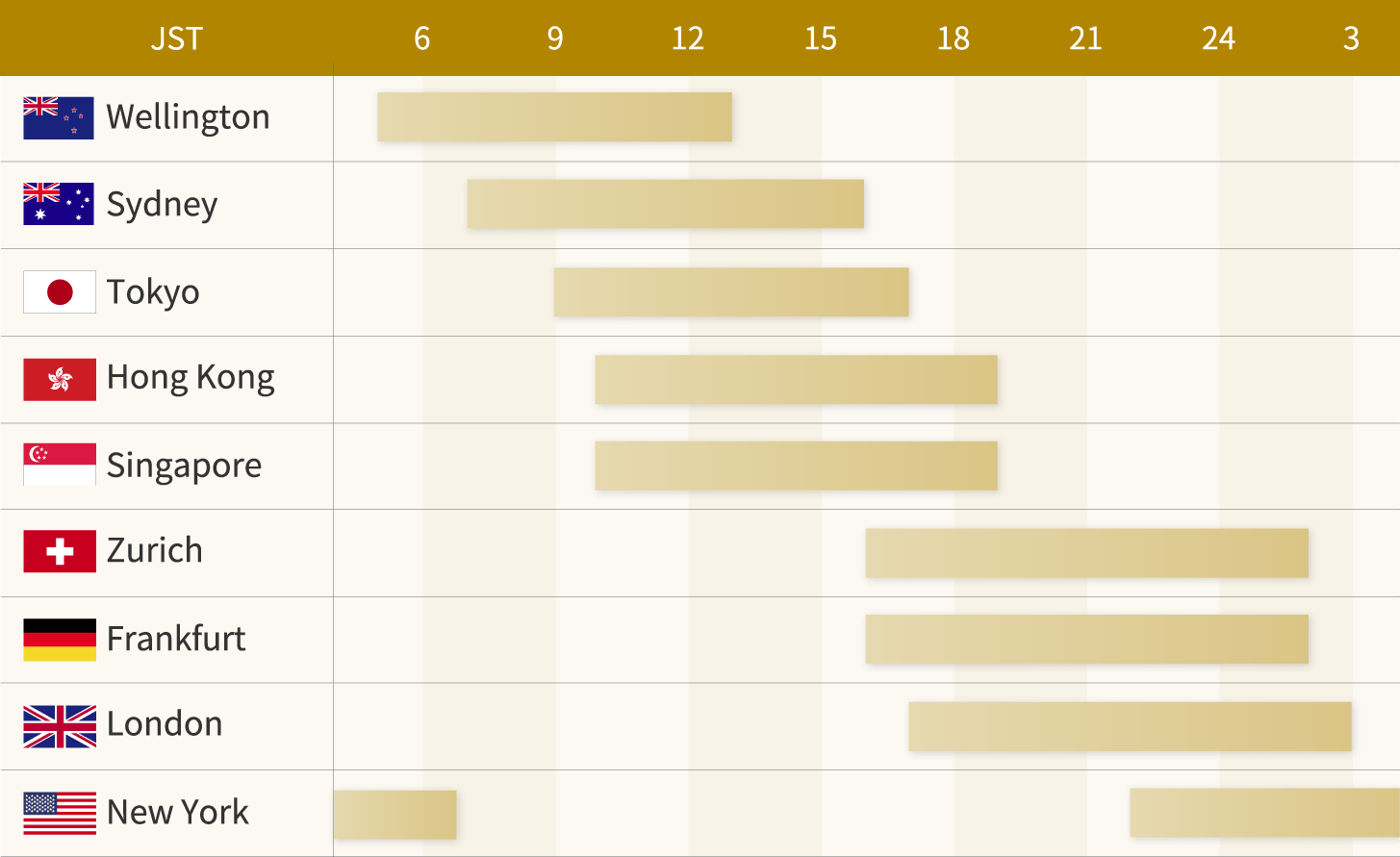
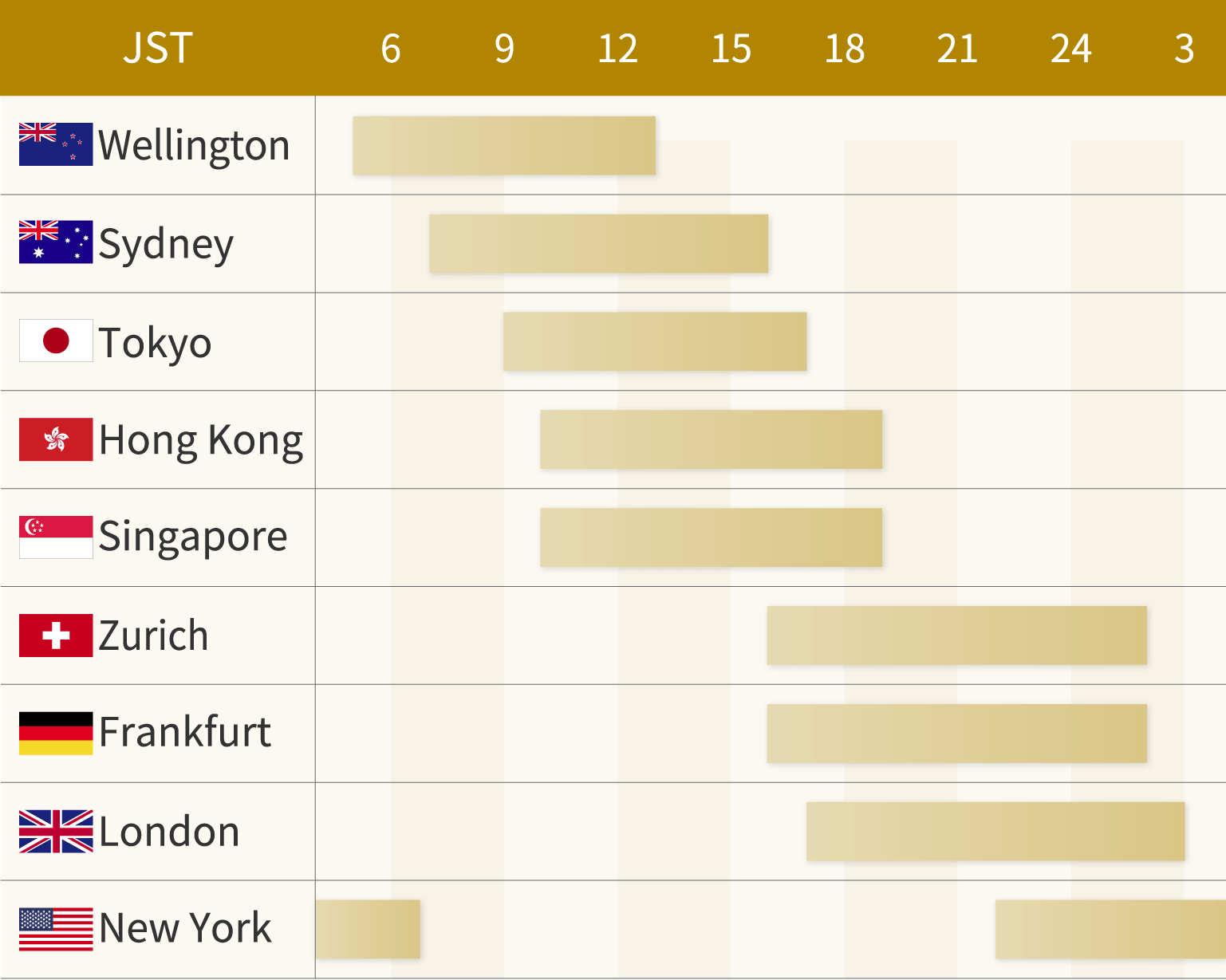
(*) These are approximate trading hours based on U.S. Daylight Saving Time.

Oceania Time
The Oceania trading session begins around 5:00 a.m. Japan Standard Time, when markets such as Wellington, New Zealand, and Sydney, Australia, open. Because the market is small—meaning there are few traders active during the Oceania session—spreads tend to widen, and this is a time when prices are prone to sharp fluctuations.
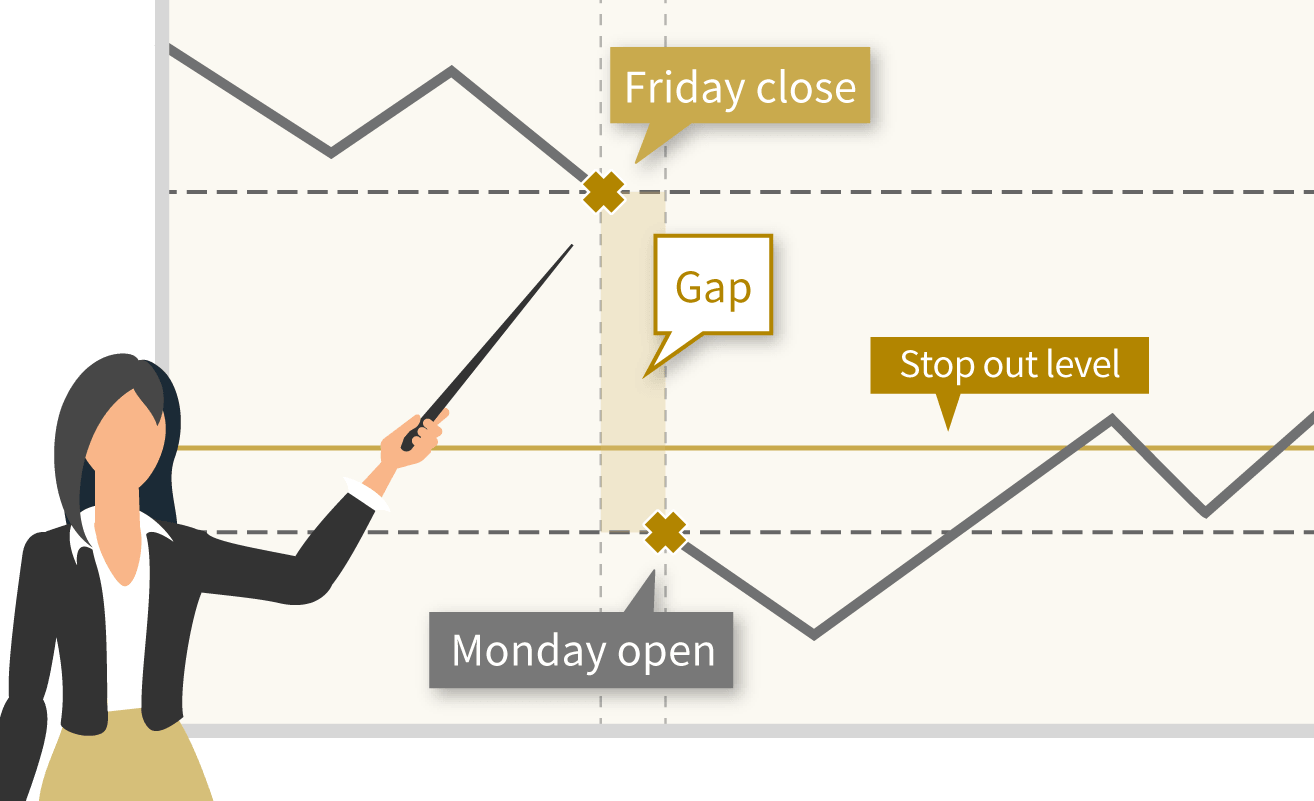
Additionally, since it is the first market to open on Monday, you should be aware that “gaps” (the price difference between Friday’s closing price and Monday’s opening price) are likely to occur.By taking into account the possibility of a “gap” opening during Oceania trading hours on Monday, you can make informed decisions about whether to carry positions over from Friday and, if so, appropriately manage your margin maintenance ratio.
Tokyo Time
Trading in Tokyo begins around 8:00 a.m. Japan Standard Time. Markets across Asia open sequentially, starting with Tokyo, followed by Hong Kong and then Singapore. Trading tends to be active until 9:55 a.m., when Japanese financial institutions announce the day’s mid-market rate (benchmark rate), after which the market generally calms down.
One thing to pay particular attention to during Tokyo trading hours is the monthly “Goto Day.” On “Goto Days”—dates that are multiples of 5—settlement transactions, primarily by import companies selling yen and buying dollars, tend to cause the USD/JPY exchange rate to rise until the mid-market rate is announced.Additionally, between 9:00 a.m. and 3:00 p.m., when domestic stock trading takes place, cross-yen pairs are susceptible to fluctuations in the Nikkei 225, so it is essential to closely monitor stock market trends as well.
London Time (European Time)
London trading hours are the time period centered on European markets—such as those in Zurich, Frankfurt, and London—and begin around 3:00 p.m. Japan Standard Time.Trading becomes active around 5:00 p.m., when the London market—which boasts the world’s highest trading volume—opens, and currencies such as the euro and the British pound are actively traded. Please also note that this is the time when key European economic indicators are released, so market prices may fluctuate significantly depending on the results.
While London trading hours tend to have higher liquidity than Tokyo trading hours and are more prone to trends, they are also characterized by frequent trend reversals. Although the market calms down around 7:00 p.m., trading activity peaks during the day from around 9:00 p.m. to 2:00 a.m., as this is when New York and London trading hours overlap.
New York time
Trading begins around 9:00 p.m. Japan Standard Time. Since this period overlaps with London trading hours from 9:00 p.m. to 2:00 a.m., it is the most active trading period of the day. While this is a time when strong trends tend to form, it is also when statements by key U.S. officials and the release of important economic indicators—which can significantly impact the market—often occur. Therefore, it is important to check the schedule of upcoming events in advance before starting to trade.
Although trading is available during New York trading hours until early morning Japan Standard Time, please be aware that Exness credits swap points at 6:00 a.m. (7:00 a.m. during daylight saving time), which is the rollover time, so please be careful to avoid incurring unintended negative swap charges.Additionally, if you carry a position over the weekend, you must take into account the possibility that your margin maintenance ratio could drop significantly due to a “gap” in the market opening on Monday.
Important Notes on Exness Trading Hours
At Exness, you can trade at any time during trading hours, but please note the following regarding trading hours and non-trading hours.
Be cautious when trading around the release of key economic indicators and statements by key figures
Caution is advised around the time of economic indicator releases or statements by key figures in countries related to the securities you’re trading, as the market is prone to sudden fluctuations. Prior to the release of employment statistics reflecting a country’s economic conditions, announcements of policy interest rates that affect future economic trends, or statements by key figures from central banks and major institutions, liquidity tends to decrease as traders adopt a wait-and-see approach.Furthermore, immediately after such announcements, depending on the results, funds may flood into the market all at once, making it prone to strong trends or volatile swings with no clear direction. Therefore, please be sure to trade strategically around major events—such as refraining from trading or employing hedging strategies.
In addition, Exness publishes a “Market Report” every evening, providing updates on market conditions and upcoming events to watch. We encourage you to use this report as a reference for your trading.
Be careful about holding positions overnight
If you carry a position over to the next day, please be aware of negative swap charges and "gaps" at the start of the week.
Be aware of the possibility of negative swaps
If you carry a position over to the next day with Exness, swap points will be applied at 6:00 a.m. Japan Standard Time (7:00 a.m. during daylight saving time). If the swap points are positive, they will be credited to your MT4/MT5 trading account as profit; if they are negative, they will be deducted from your trading account as a loss.Swap points vary by instrument, and negative swap points can significantly impact your trading results. Therefore, be sure to check the swap points before initiating any trades with the intention of rolling over your position to the next day.
Exness Swap Point Update Times (Japan Time)
| Daylight Saving Time | 6:00 |
| Standard Time | 7:00 |
Additionally, Exness offers “Swap-Free” accounts, which do not incur swap points, so you can engage in long-term trading without worrying about losses from negative swaps. There are two types of Swap-Free accounts: standard Swap-Free, which applies to all traders regardless of the instrument, and Extended Swap-Free, which is automatically applied or removed based on a trader’s trading activity.If you want to aim for long-term capital gains while avoiding negative swap charges, please take advantage of our Swap-Free accounts.
Swap points refer to the interest rate differential that arises in FX trading involving currencies from two countries with different policy interest rates; they are also known as “interest rate differential adjustments.” By selling a low-interest-rate currency and buying a high-interest-rate currency, you receive the interest rate differential as swap points; conversely, you pay them in the opposite scenario. Swap points accrue daily as long as you hold the position.Please note that swap points for the following weekend—when no swap points are charged—are accrued on Wednesday as “triple swap points” (for energy CFDs, this occurs on Friday).
Watch Out for the "Gap" at the Start of the Week
Please be aware that when holding a position over the weekend, there is a possibility of a significant “gap” opening at the start of the week.A “gap” refers to the price difference between the closing price early Saturday morning—when trading for the week ends—and the opening price on Monday morning. Although major foreign exchange markets are closed over the weekend, trading continues in some markets in the Middle East, so exchange rates fluctuate even on Saturdays and Sundays.Although the markets open over the weekend are small and trading volume is low, if an unexpected event occurs over the weekend that affects the global economy, prices may move due to hedging transactions and other factors, potentially resulting in a large “gap” at the start of the week.
Due to this “window,” there is a possibility that your margin maintenance ratio could drop significantly early Monday morning, triggering a stop-out (forced liquidation); therefore, we recommend that you refrain from holding positions over the weekend. If you wish to hold a position for the long term, please ensure you have sufficient margin in your trading account.
You cannot place orders outside of trading hours.
On weekends—which are outside of Exness’s trading hours—as well as on global holidays such as Christmas and the New Year’s holiday period, not only manual orders and closures but also automated functions such as limit orders and closures, as well as EA (automated trading) transactions, will be unavailable.While sudden events such as conflicts or terrorist attacks may cause significant currency fluctuations outside of trading hours, stop-loss orders will not be executed. Therefore, please exercise extreme caution when holding positions over the weekend or during the Christmas and New Year’s holidays.
Exness Trading Hours: Frequently Asked Questions (FAQ)
-
Where can I find the trading hours for each instrument on Exness?
You can check the trading hours for each instrument on Exness via MT4/MT5. Right-click on the instrument name in the Watchlist, select “Specifications,” and the trading conditions screen will appear, allowing you to view the trading hours for each instrument. Please note that there is a 9-hour time difference between the time displayed in MT4/MT5 and Japan Standard Time.
Read More
24.08.2022
-
Can I manage my orders for Exness stock CFDs even outside of trading hours?
Yes, at Exness, for certain stock CFD instruments, you can only place orders to close open positions during the pre-market session, which runs from 7:00 PM to 10:40 PM before the market opens. The pre-market is an after-hours trading session that takes place before the regular trading hours of the U.S. stock market.
Read More
24.08.2022
-
Can I manage my orders outside of trading hours on Exness?
No, at Exness, you cannot place new orders or close open positions on weekends (Saturday and Sunday) or during holidays such as Christmas and the New Year’s holiday period, which fall outside of trading hours. Please note that not only manual orders and closings but also limit orders and closings, as well as EA (automated trading) transactions, are unavailable during these times, so please exercise caution when holding positions overnight.
Read More
24.08.2022
-
Is the server time on Exness's MT4/MT5 different from Japan Standard Time?
Yes, Exness uses Greenwich Mean Time (GMT+0) as the server time for MetaTrader 4 (MT4) and MetaTrader 5 (MT5), so there is a 9-hour time difference from Japan Standard Time. You can convert the time displayed in MT4/MT5 to Japan Standard Time by adding 9 hours.
Read More
24.08.2022
-
Do trading hours vary by instrument at Exness?
Yes, at Exness, trading hours vary by instrument. For all instruments except cryptocurrency CFDs, you can trade 24 hours a day from early Monday morning to early Saturday morning, but the opening and closing times differ by instrument. Cryptocurrency CFDs can be traded 24 hours a day, 365 days a year, including weekends and holidays.
Read More
24.08.2022