















Trading Crude Oil with Exness
Transaction
Trading Crude Oil with Exness
Exness offers two types of crude oil contracts: UKOIL (Brent crude) and USOIL (WTI crude). Exness’s crude oil contracts are particularly popular among traders because they are highly volatile and offer the potential to generate significant profits in a short period of time.
You can trade Exness’s crude oil instruments with a fixed leverage of 200x or 1,000x. Furthermore, Exness’s WTI crude oil is “swap-free,” meaning no swap points are charged, allowing you to enjoy long-term trading strategies while keeping costs low.
Features of Exness Crude Oil
At Exness, you can trade two types of crude oil contracts via CFDs (Contracts for Difference). Please familiarize yourself with the characteristics of these highly volatile crude oil contracts to ensure a smooth trading experience.
Exness's crude oil has high liquidity
Exness’s crude oil is characterized by high liquidity. As a result, spreads are relatively tight, offering the advantage of lower trading costs.Furthermore, since crude oil is highly susceptible to global economic and geopolitical factors, it is a recommended asset for those looking to engage in short-term trading by capitalizing on price fluctuations. While crude oil prices fluctuate frequently, Exness allows you to enjoy trading while minimizing those risks.
Exness's crude oil tends to form strong, long-term trends
Exness crude oil is characterized by a tendency to form strong, sustained trends. When a trend is strong, prices tend to move in one direction over the long term even amid repeated short-term fluctuations, allowing you to engage in short-term trading while aiming for medium- to long-term profits.Furthermore, since Exness’s crude oil trading has no expiration date, you can hold positions for the long term without worrying about contract expiration.
Exness Crude Oil CFD Trading
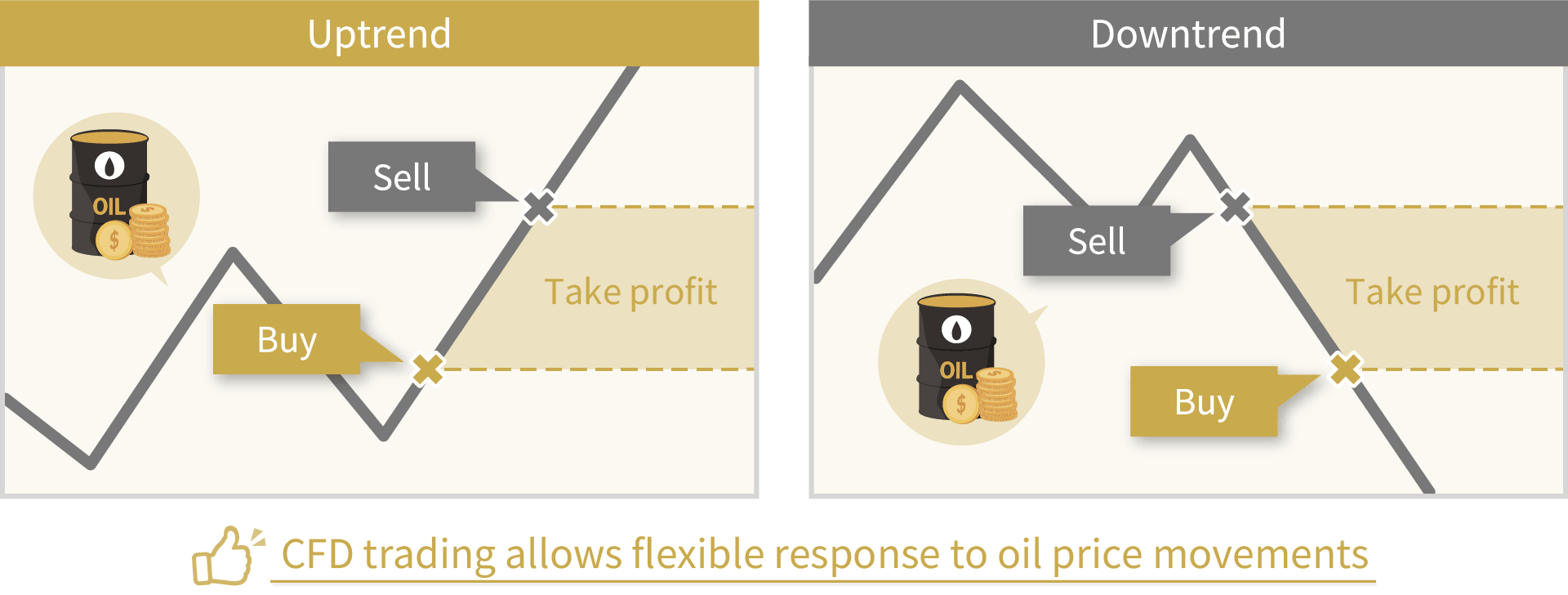
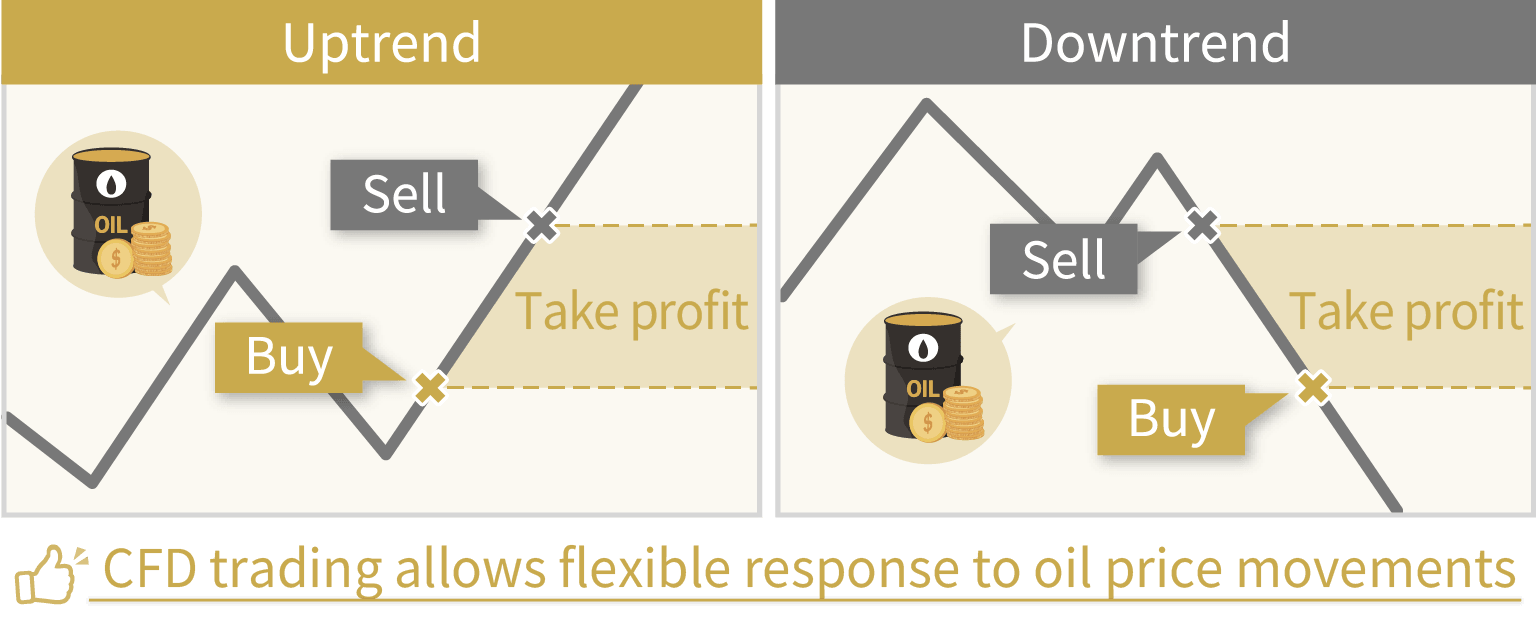
At Exness, you can trade two types of crude oil contracts via CFDs (Contracts for Difference).In CFD trading, your profit or loss is determined by the difference between the opening and closing prices. You can take a long position when prices are rising and a short position when they are falling, allowing you to capitalize on trading opportunities in both rising and falling markets.
For example, when crude oil prices spike due to the release of economic indicators or other factors, you can profit by taking a long position.On the other hand, when prices fall due to shifts in the balance between supply and demand, you can aim to profit by holding a short position. In this way, Exness’s CFD trading allows you to develop flexible strategies and trade in a way that maximizes the price fluctuations unique to the crude oil market.
Exness Crude Oil Price Movements
When trading crude oil on Exness, it is important to understand the characteristics of crude oil price movements. By understanding the best times to trade and the optimal timing, you can enjoy trading crude oil while minimizing risk.
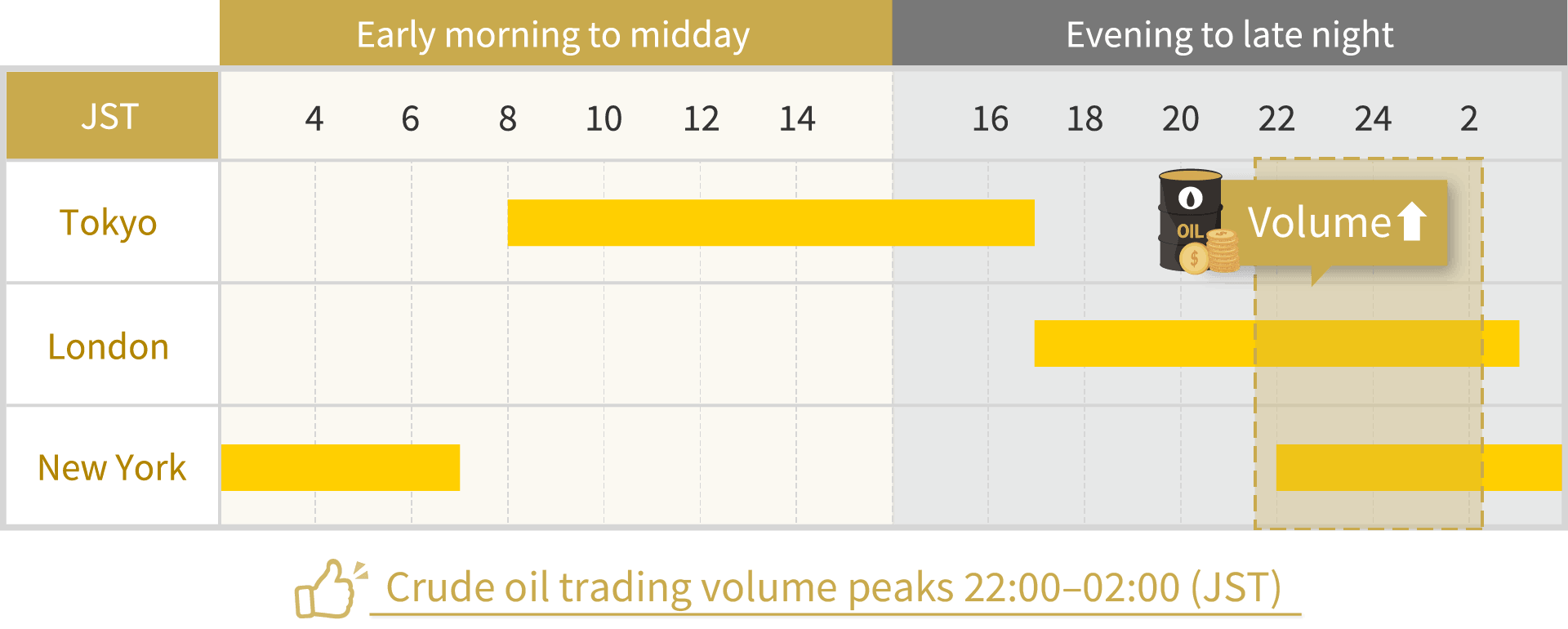
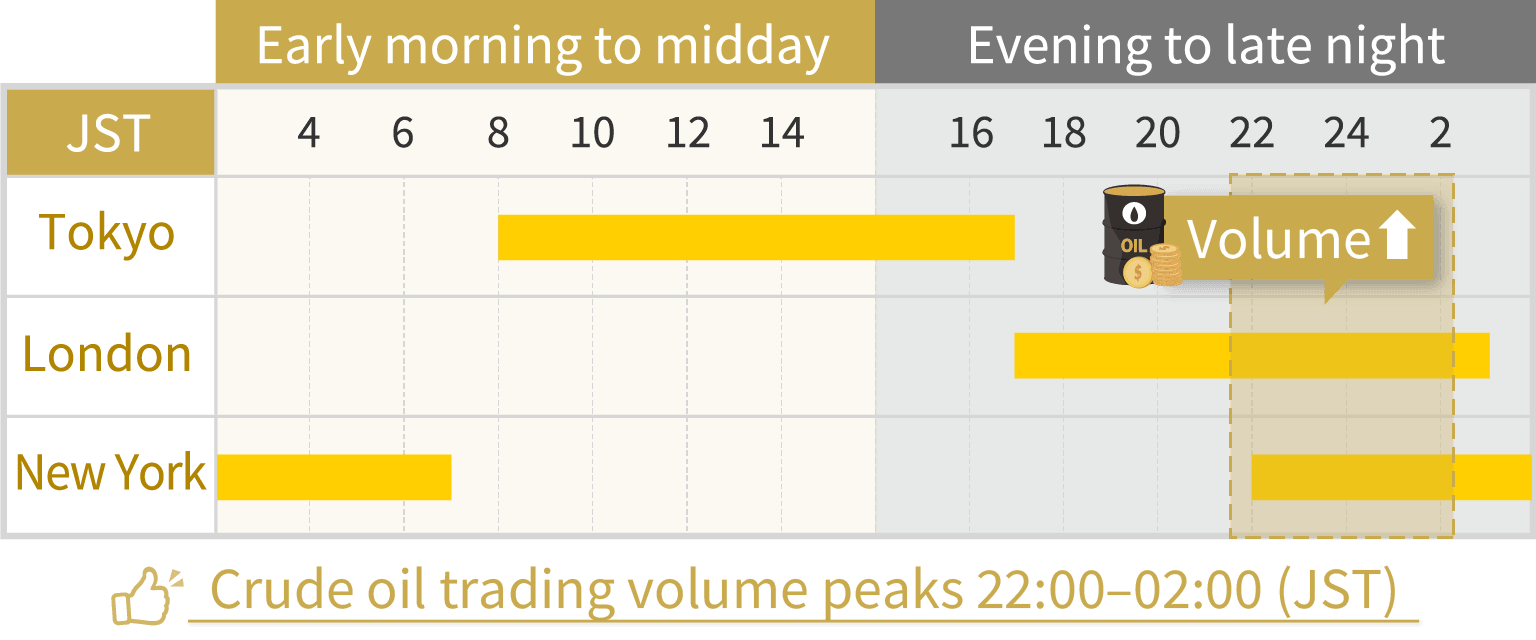
Trading volume is highest between 10:00 p.m. and 2:00 a.m. Japan Standard Time.
Trading in Exness’s crude oil contracts is generally available from early Monday morning through early Saturday morning. Within this period, trading volume for crude oil contracts peaks between 10:00 PM and 2:00 AM Japan Standard Time—the hours when London and New York trading sessions overlap, which are known for their particularly high trading volume in the foreign exchange market.During this time, liquidity is high, which tends to narrow spreads, offering you the chance to trade under more favorable conditions. Take advantage of short-term trading strategies to enjoy efficient crude oil trading.
Be on the lookout around the time of the release of the U.S. weekly petroleum inventory report
When trading crude oil on Exness, you should pay close attention to the timing of the release of the “U.S. Weekly Petroleum Inventory Report.” Crude oil prices may fluctuate significantly depending on the results of the “U.S. Weekly Petroleum Inventory Report,” which is released every Wednesday at 23:30 Japan Standard Time (0:30 during daylight saving time).The U.S. Weekly Petroleum Inventory Report is a report on domestic petroleum inventory levels in the United States published by the U.S. Energy Information Administration (EIA).
Every Wednesday, figures for the previous Friday are released for various petroleum products, including crude oil, distillates, diesel fuel, and kerosene. These figures are important indicators for comprehensively evaluating trading strategies that take into account not only simple changes in inventory levels but also other fundamental factors and price trends.Since crude oil inventories are influenced by the status of petroleum inventories, please exercise extreme caution when trading around the time of the release of petroleum inventory statistics to mitigate risk.
Fluctuations Due to the Balance of Supply and Demand
Crude oil prices on Exness fluctuate based on the prevailing balance of supply and demand in the market. Global economic trends—particularly in the United States, the world’s largest oil consumer—as well as global demand for gasoline and demand for heating oil during the winter months have a significant impact on prices. The main factors influencing crude oil price fluctuations are as follows.
OPEC General Assembly
Crude oil prices on Exness are influenced by OPEC (Organization of the Petroleum Exporting Countries) member nations adjusting their production levels in response to global demand. For this reason, developments among oil-producing nations—particularly those within OPEC—are closely watched.For example, in 2020, amid the COVID-19 pandemic, OPEC and its allies agreed to cut oil production to stabilize prices. However, due to disagreements with Russia—a major exporter despite not being an OPEC member—Saudi Arabia decided to increase production. As a result, crude oil prices plummeted.
Global Economic Conditions
During periods of economic growth, demand for crude oil increases to meet the needs of industries such as energy, transportation, manufacturing, and pharmaceuticals; as demand exceeds supply, oil prices rise. The development of the global economy is a critical factor in crude oil demand.When the global economy recovers, rising demand drives up crude oil prices; when the global economy slows down, demand decreases and crude oil prices fall.
Political instability and geopolitical risks in oil-producing countries
One of the factors that cause fluctuations in Exness’s crude oil prices is political instability and geopolitical risks in the Middle East and North Africa.The Middle East is home to many of the world’s leading oil-producing countries and is subject to various geopolitical risks. Political instability in these oil-producing countries tends to disrupt oil supplies, causing crude oil prices to rise.
Production Cuts by Crude Oil-Producing Countries
Exness crude oil prices may be affected by production cut policies implemented by oil-producing countries.When demand for crude oil declines and a surplus of crude oil arises, this surplus is typically stored in storage facilities. However, since crude oil storage capacity is limited, once facilities reach full capacity, concerns about an oversupply of crude oil may rise, which could affect market prices.
Shifting to Other Energy Resources
As climate change becomes a global issue, energy companies are accelerating the transition to alternative energy sources such as solar, wind, and hydroelectric power. The production of these new energy resources is increasing year by year, and shifts in their share of the total energy mix could affect both crude oil demand and prices.
Exness Crude Oil Trading Conditions
Exness offers two types of crude oil instruments: UKOIL (Brent crude) and USOIL (WTI crude).Exness’s crude oil contracts can be traded on four account types, excluding the Standard Cent account; however, trading conditions vary by account type. Please review the following trading conditions before trading crude oil with Exness.
Exness Crude Oil Trading Instruments
There are two types of crude oil contracts available for trading on Exness:
UKOIL (Brent Crude Oil)
Exness’s UKOIL (Brent Crude) is widely recognized as a benchmark crude oil produced in the North Sea and has been listed on the IPE (now ICE Futures Europe) since 1988.The name “Brent crude” derives primarily from the Brent oil fields in the North Sea, which operate off the coasts of England, Norway, Denmark, and the Netherlands.
It has an API gravity of approximately 38 degrees and a sulfur content of 0.38%.In terms of quality, it falls between WTI, Dubai, and Oman crude oils. Because Brent crude is light and has a low sulfur content, it is relatively easy to refine into high-quality fuels such as gasoline and diesel. Due to these characteristics, Brent crude is in high demand worldwide and plays a key role, particularly in the European, African, and Middle Eastern markets.
USOIL (WTI Crude Oil)
Exness’s USOIL (WTI crude oil) is high-quality crude oil produced in the U.S. state of Texas.It has been listed on the NYMEX (New York Mercantile Exchange) since 1983. “WTI” stands for West Texas Intermediate, which accounts for about 6% of crude oil produced in the United States and 1–2% of global crude oil production.
The USOIL market boasts the world’s largest trading volume in crude oil futures and is used as a benchmark for crude oil grades not only in North America but around the world. Since NYMEX deliveries take place in Cushing, Oklahoma—which borders Texas—crude oil prices may be affected by congestion at the delivery location.
USOIL is a high-quality crude oil with an API gravity of 39 degrees or higher, making it very light, and a low sulfur content of about 0.2%. Because it can be relatively easily refined into high-quality fuels such as gasoline and diesel, it is also referred to as “light, sweet crude.”
Exness Crude Oil Trading Hours (Japan Time)
At Exness, you can trade two types of crude oil contracts—UKOIL (Brent Crude) and USOIL (WTI Crude)—from early Monday morning through early Saturday morning (excluding maintenance periods). Please note, however, that trading is suspended for approximately one hour early each weekday morning.
Exness Crude Oil Trading Hours and Trading Halts
| Stock | Summer Hours (Market Closure Hours) |
Winter Hours (Trading Suspension Hours) |
| UKOIL (Brent Crude Oil) | Mon 9:10 a.m. – Sat 5:55 a.m. (5:55 a.m. – 9:10 a.m.) |
Mon 10:10 a.m. – Sat 6:55 a.m. (6:55 a.m. – 10:10 a.m.) |
| USOIL (WTI Crude Oil) | Mon 7:10 a.m. – Sat 5:45 a.m. (5:45 a.m. – 7:10 a.m.) |
Mon 8:10 a.m. – Sat 6:45 a.m. (6:45 a.m. – 8:10 a.m.) |
| Summer Hours (Market Closure Hours) | |
| UKOIL | Mon 9:10 a.m. – Sat 5:55 a.m. (5:55 a.m. – 9:10 a.m.) |
| USOIL | Mon 7:10 a.m. – Sat 5:45 a.m. (5:45 a.m. – 7:10 a.m.) |
| Winter Hours (Trading Suspension Hours) | |
| UKOIL | Mon 10:10 a.m. – Sat 6:55 a.m. (6:55 a.m. – 10:10 a.m.) |
| USOIL | Mon 8:10 a.m. – Sat 6:45 a.m. (6:45 a.m. – 8:10 a.m.) |
Exness observes daylight saving time, so trading hours vary between “daylight saving time” and “standard time.” Please note that when the clock changes from standard time to daylight saving time, the opening and closing times of foreign exchange markets in various countries will be moved up by one hour.

Exness Crude Oil Leverage
The leverage applied to Exness’s crude oil instruments is always fixed at 200x or 1,000x, regardless of your account type or leverage settings.This fixed leverage allows you to trade crude oil—a highly liquid market with volatile price movements—while hedging your risk and aiming for profits.
Exness Leverage for Crude Oil Contracts
| Stock | Leverage (Fixed) |
| UKOIL (Brent Crude Oil) | 200 times |
| USOIL (WTI Crude Oil) | 1,000 times |

Exness: Required Margin for Crude Oil
The margin required for trading crude oil on Exness can be calculated using the following formula.
How to Calculate the Required Margin for Exness Crude Oil Contracts
Required Margin = Trade Volume × Leverage × Current Rate
For example,When the price of UKOIL (Brent crude oil) is $70, if you trade 0.01 lot (1,000 units) using a fixed leverage of 200x, the required margin is calculated as “0.1 × 1,000 ÷ 200 × 70,” which equals $3.50.If your trading account currency is the Japanese yen (JPY), use the USD/JPY exchange rate for the calculation. If 1 USD equals 150 JPY, the required margin would be “$3.5 × 150 JPY/USD = 525 JPY.”
Exness also offers a convenient investment calculator. Simply enter the required information, and it will automatically calculate your margin requirements, spreads, and other costs. We encourage you to use this tool to help ensure your trading goes smoothly.
Exness Crude Oil Spreads
When trading crude oil with Exness, the average spread varies depending on the account type you use. Additionally, since Standard and Pro accounts allow you to trade without commissions, your effective trading costs consist solely of the spread. The average spreads for crude oil trading with Exness are as follows.
Exness Average Spreads for Crude Oil Contracts (Current)
| Stock Name | Standard Account | Low-Spread Account | Zero Account | Pro Account |
| UKOIL (Brent Crude Oil) | pips | pips | pips | pips |
| USOIL (WTI Crude Oil) | pips | pips | pips | pips |
| UKOIL | |
| Standard Account | pips |
| Low-Spread Account | pips |
| Zero Account | pips |
| Pro Account | pips |
| USOIL | |
| Standard Account | pips |
| Low-Spread Account | pips |
| Zero Account | pips |
| Pro Account | pips |
(*) Spreads are subject to change, so please check the latest figures before trading.
Please note that the accounts offering the lowest spreads for trading crude oil on Exness are the “Low Spread Account” and the “Zero Account.” However, since both accounts incur trading commissions, when considering the total cost—which includes both the spread and the trading commission—the Low Spread Account allows you to trade crude oil at a relatively lower cost.
Exness Crude Oil Swap Points
At Exness, only USOIL (WTI Crude Oil) is available for swap-free trading. Swap points are the “interest rate adjustment” that occurs when you hold a position overnight into the next day or beyond.With USOIL, the swap-free feature means no swap points are charged even when positions are held overnight, allowing you to trade using a wide range of styles, from short-term to medium- and long-term trading. The swap points for Exness’s crude oil instruments are as follows.
Exness Crude Oil Swap Points (Current)
| Stock Name | Long Swap |
Short Swap |
| UKOIL (Brent Crude) | ||
| USOIL (WTI Crude Oil) |
(*) Spreads are subject to change, so please check the latest figures before trading.
Please note that UKOIL (Brent Crude) is not eligible for swap-free trading. If you carry a position over to the next day or later, the negative swap amount will be deducted as a loss, so please exercise caution when managing your positions.
Exness Crude Oil Trading Fees
Trading fees for crude oil trading on Exness vary depending on the account type you use. With Standard and Pro accounts, you can trade without any transaction fees.On the other hand, Low Spread accounts incur a commission of $3.50 per lot per side. Zero accounts incur a commission of $32.50 per side for UKOIL and $6.25 per side for USOIL, but in exchange, they offer extremely low spreads. The trading commissions for Exness’s crude oil instruments are as follows.
Exness Trading Commissions for Crude Oil Contracts
| Stock | Standard Account | Low-Spread Account | Zero Account | Pro Account |
| UKOIL (Brent Crude Oil) | - | $3.50 | $32.50 | - |
| USOIL (WTI Crude Oil) | - | $3.50 | $6.25 | - |
| UKOIL | |
| Standard Account | - |
| Low-Spread Account | $3.50 |
| Zero Account | $32.50 |
| Pro Account | - |
| USOIL | |
| Standard Account | - |
| Low-Spread Account | $3.50 |
| Zero Account | $6.25 |
| Pro Account | - |
Exness: The Correlation Between Crude Oil and Currency Pairs
At Exness, you can trade by leveraging the correlation between crude oil and currency pairs. Because crude oil plays a key role in the energy market, fluctuations in crude oil prices affect many currencies. By understanding how fluctuations in crude oil prices impact currency pairs, you can develop more effective trading strategies.
USD/CAD and WTI Crude Oil
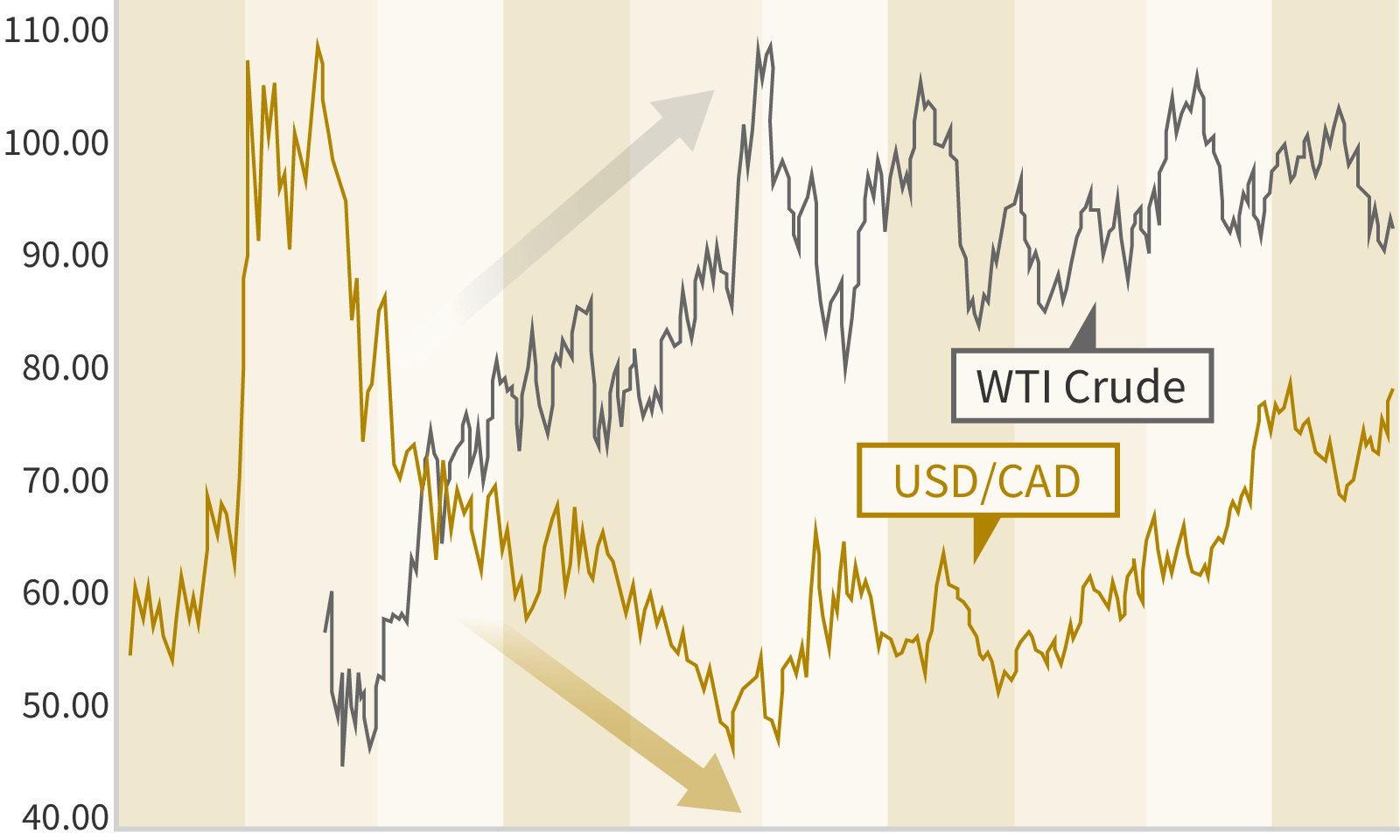
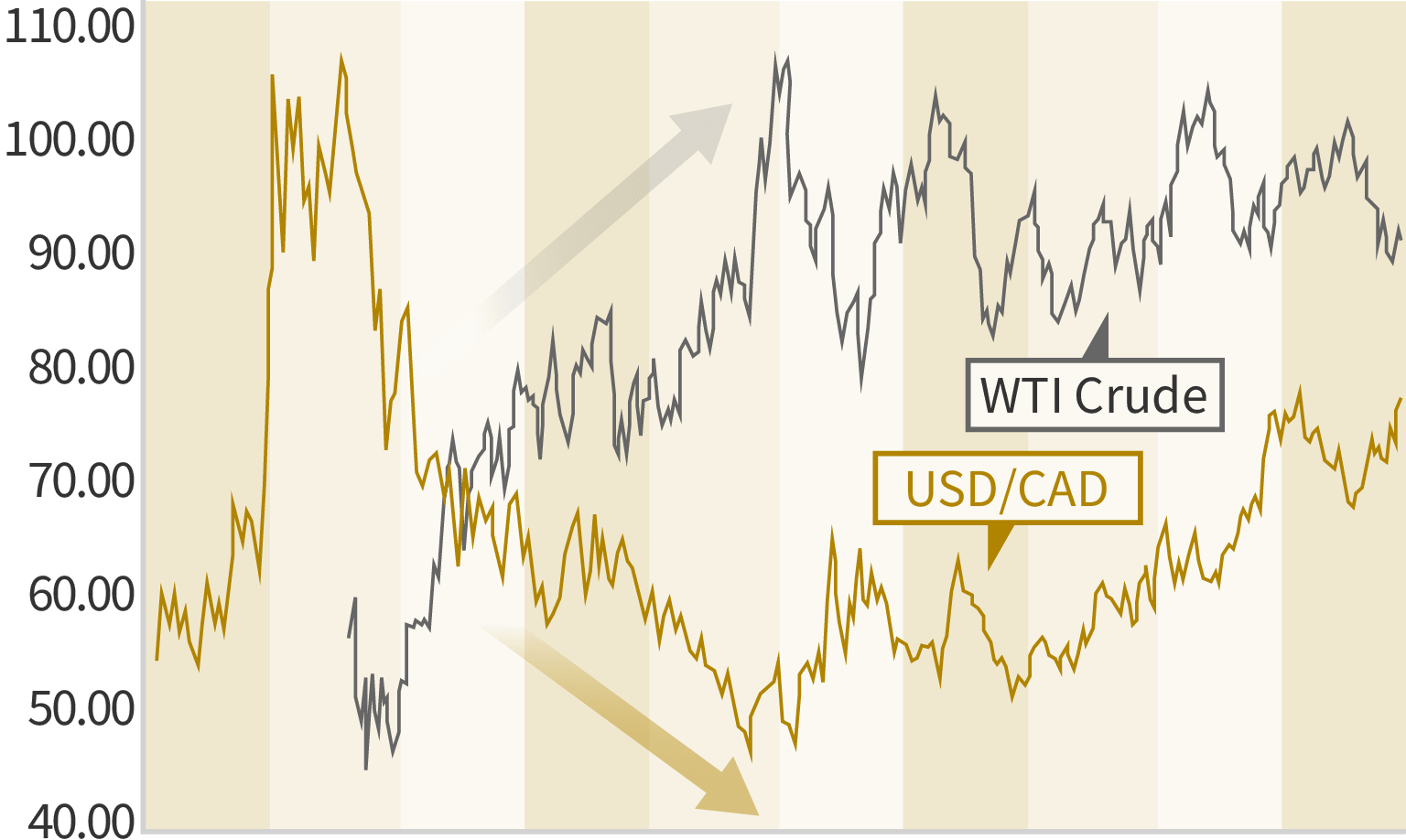
There appears to be an inverse correlation between the movements of Exness’s USD/CAD and USOIL (WTI crude oil). The United States is the world’s largest consumer of crude oil, consuming approximately 19 million barrels per day.Much of this is imported from countries such as Canada, Mexico, and Saudi Arabia, with the remainder coming from domestic production and imports from other countries. Since crude oil exports to the United States are a vital economic resource for Canada, fluctuations in WTI crude oil prices often have a direct impact on the Canadian economy and the Canadian dollar.
For example, when WTI crude oil prices rise, Canada’s revenue from crude oil exports increases, which has a positive effect on the economy. As a result, if the value of the Canadian dollar rises, the USD/CAD exchange rate tends to fall. On the other hand, it is important to note that when WTI crude oil prices fall, the value of the Canadian dollar tends to decline, causing the USD/CAD exchange rate to rise.
U.S. Dollar/Norwegian Krone and Brent Crude Oil
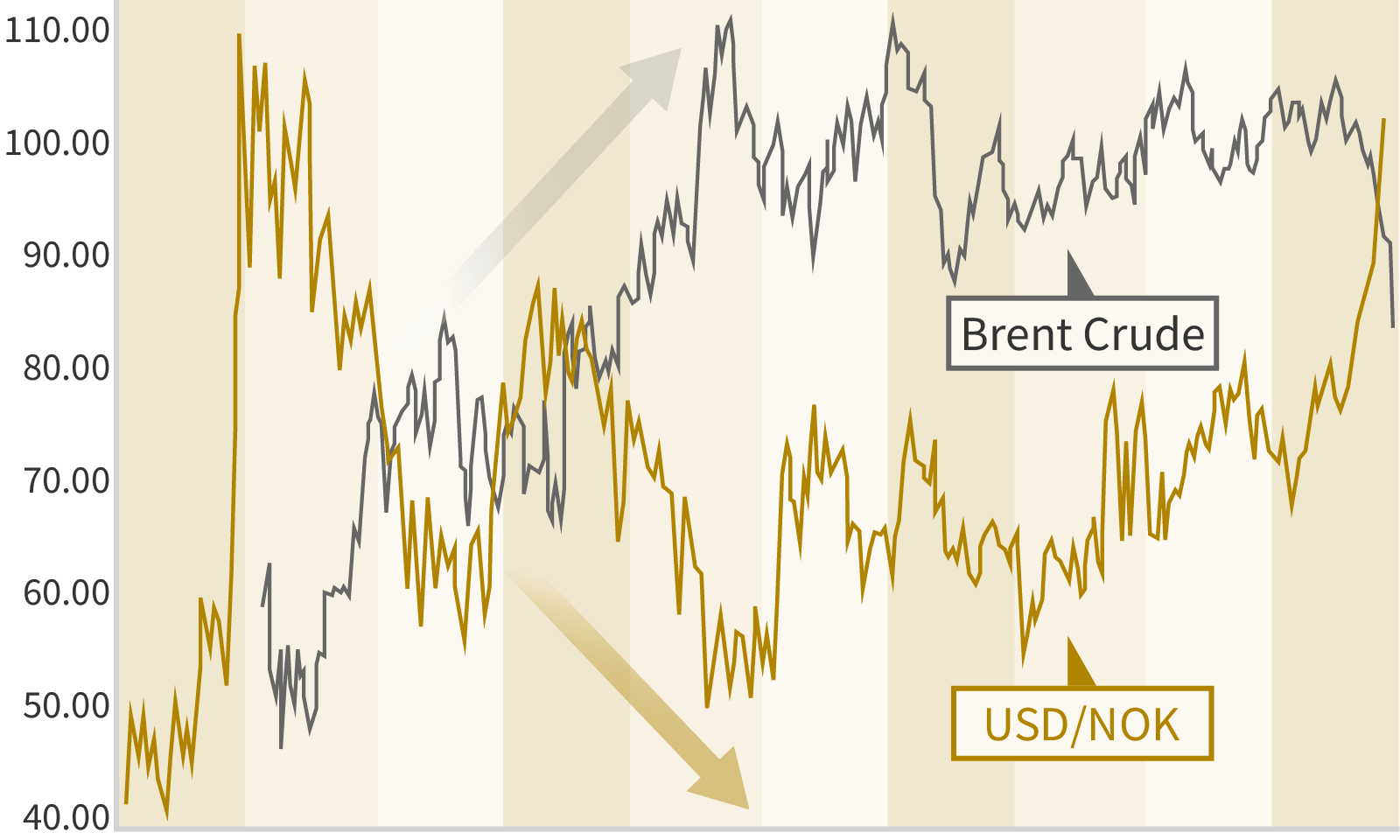
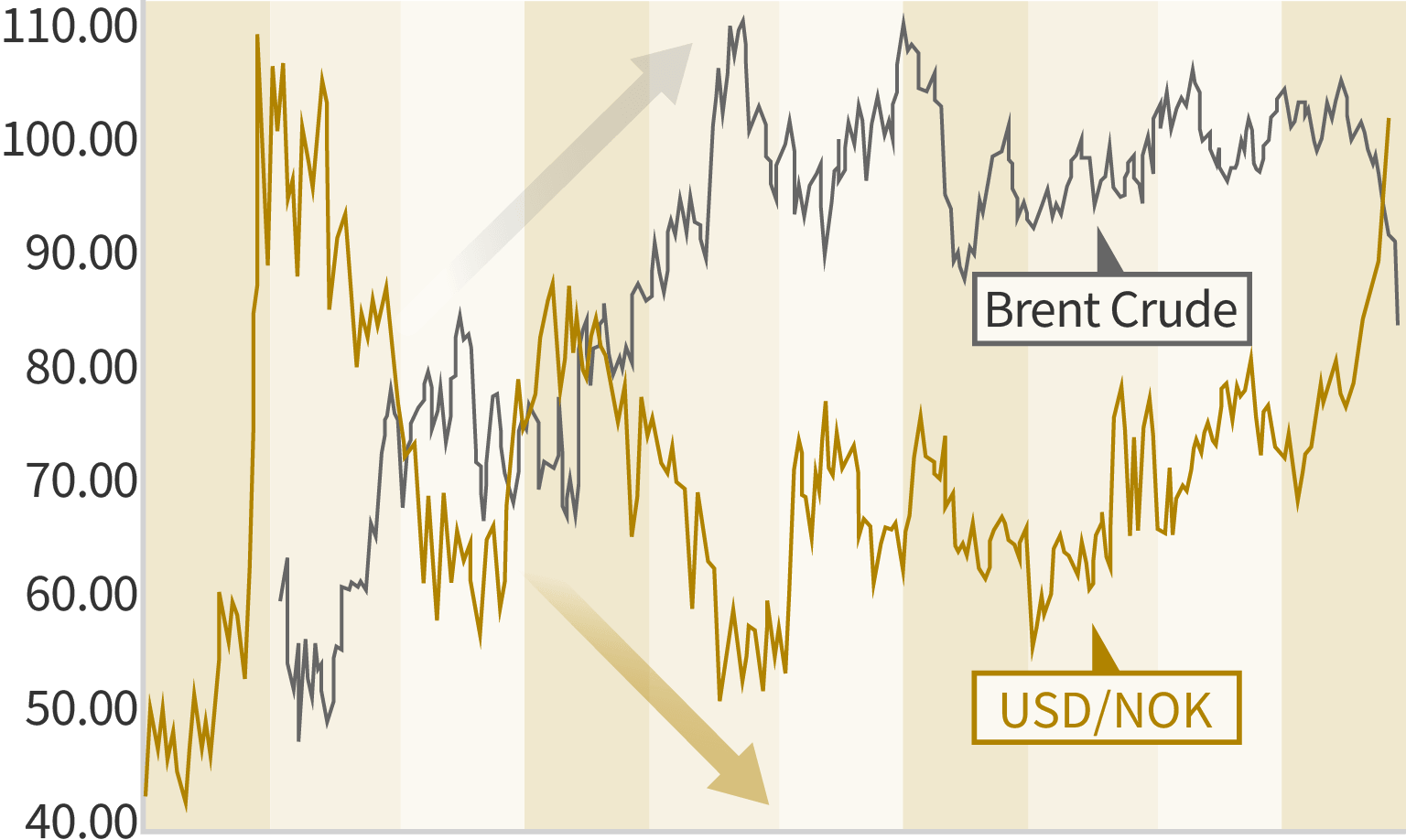
Exness’s USD/NOK and UKOIL (Brent crude oil) pairs tend to show an inverse correlation. Norway is one of the world’s leading crude oil exporters.The economy is centered on the oil industry, which accounts for more than 20% of the country’s gross domestic product (GDP), and this often has a direct impact on the value of the Norwegian krone.
For example, when the price of Brent crude oil rises, Norway’s revenue from crude oil exports increases, which has a positive impact on the economy. As a result, the value of the Norwegian krone tends to rise, causing the USD/NOK exchange rate to fall.On the other hand, it is important to note that when Brent crude oil prices fall, the value of the Norwegian krone tends to decline, causing the USD/NOK exchange rate to rise.
Important Points to Note When Trading Crude Oil with Exness
When trading crude oil on Exness, please keep the following points in mind.
Crude oil is available for CFD trading only
At Exness, you can trade all financial instruments, including crude oil, via CFDs (Contracts for Difference).Exness’s CFD trading system allows you to trade based on the difference in price resulting from buying and selling, without actually holding the underlying asset. Please note that Exness does not offer futures trading for financial instruments, including crude oil. While CFD trading allows you to trade with amounts exceeding your margin by utilizing leverage, please be aware that it also carries the risk of losses.
Crude oil is excluded from the application of leverage of up to 2,000 times
Crude oil trading on Exness is subject to leverage restrictions, so the maximum leverage is fixed at 200x or 1,000x. Please note that the high leverage of up to 2,000x (*), which is one of Exness’s key features, does not apply.Additionally, Exness’s crude oil instruments are subject to periods known as “High Margin Requirement (HMR),” during which the required margin amount is increased in response to major events affecting the market or during specific time periods. Please note that during these HMR periods, the leverage for UKOIL (Brent crude) and USOIL (WTI crude) is fixed at 20x.
(*) Leveraged trading involves high risk, and you may lose all of your invested capital. Please ensure you fully understand the risks before trading.
You cannot trade crude oil in a Standard Cent account.
Please note that you cannot trade crude oil on a Standard Cent account with Exness. Exness offers a total of five account types, but only four of them—the “Standard Account,” “Low Spread Account,” “Zero Account,” and “Pro Account”—allow trading of energy CFDs, including crude oil.If you do not have an eligible account, please open a different account type in your Personal Area. Exness allows you to hold up to 100 accounts per MT4 or MT5 platform, for a total of 200 accounts, so you can open the account type that best suits your trading instruments and strategies.
Crude oil is excluded from the triple swap
Exness offers a “Triple Swap” promotion every Wednesday, where swap points for three days—including Saturday and Sunday—are credited in a single batch. However, this Triple Swap promotion does not apply to energy products, including Exness’s UKOIL (Brent Crude) and USOIL (WTI Crude).If you hold a position overnight, a rollover fee (swap points) will be charged for each day, so please exercise caution when managing your positions.
Exness: Frequently Asked Questions (FAQ) About Crude Oil
-
Can I trade crude oil on Exness without paying any commissions?
Yes, with Exness, you can trade crude oil without any transaction fees on Standard and Pro accounts. Please note that on Low Spread and Zero accounts, separate transaction fees apply. If you want to keep trading costs down, you should compare the effective costs—which include both the spread and the transaction fees.
Read More
29.11.2024
-
Are there swap points on crude oil trades with Exness?
Yes, swap points are charged on crude oil trades with Exness. Swap points for crude oil vary by instrument; UKOIL (Brent crude) incurs swap points. USOIL (WTI crude) is swap-free, so no swap points are charged even if you hold a position overnight.
Read More
29.11.2024
-
Are there any leverage restrictions on crude oil trading with Exness?
Yes, there are leverage restrictions on crude oil trading with Exness. Crude oil instruments have a fixed leverage ratio, regardless of your account type or leverage settings. However, please note that during periods of major events that affect the market or during specific time frames (HMR), the leverage is fixed at 20x.
Read More
29.11.2024
-
Please tell me the trading hours for crude oil on Exness.
Trading hours for crude oil on Exness are as follows: UKOIL (Brent Crude) is available from 9:10 a.m. on Monday to 5:55 a.m. on Saturday during Daylight Saving Time, and from 10:10 a.m. on Monday to 6:55 a.m. on Saturday during Standard Time;USOIL (WTI Crude) is available for trading from 7:10 a.m. on Monday to 5:45 p.m. on Saturday during Daylight Saving Time, and from 8:10 a.m. on Monday to 6:45 p.m. on Saturday during Standard Time. Please note that there is a trading halt of approximately one hour early in the morning on weekdays.
Read More
29.11.2024
-
Can I trade crude oil on Exness?
Yes, at Exnss, we offer two types of crude oil contracts: UKOIL (Brent crude) and USOIL (WTI crude). You can trade these contracts using the Standard, Low Spread, Zero, and Pro account types; however, please note that you cannot trade crude oil contracts using the Standard Cent account.
Read More
29.11.2024